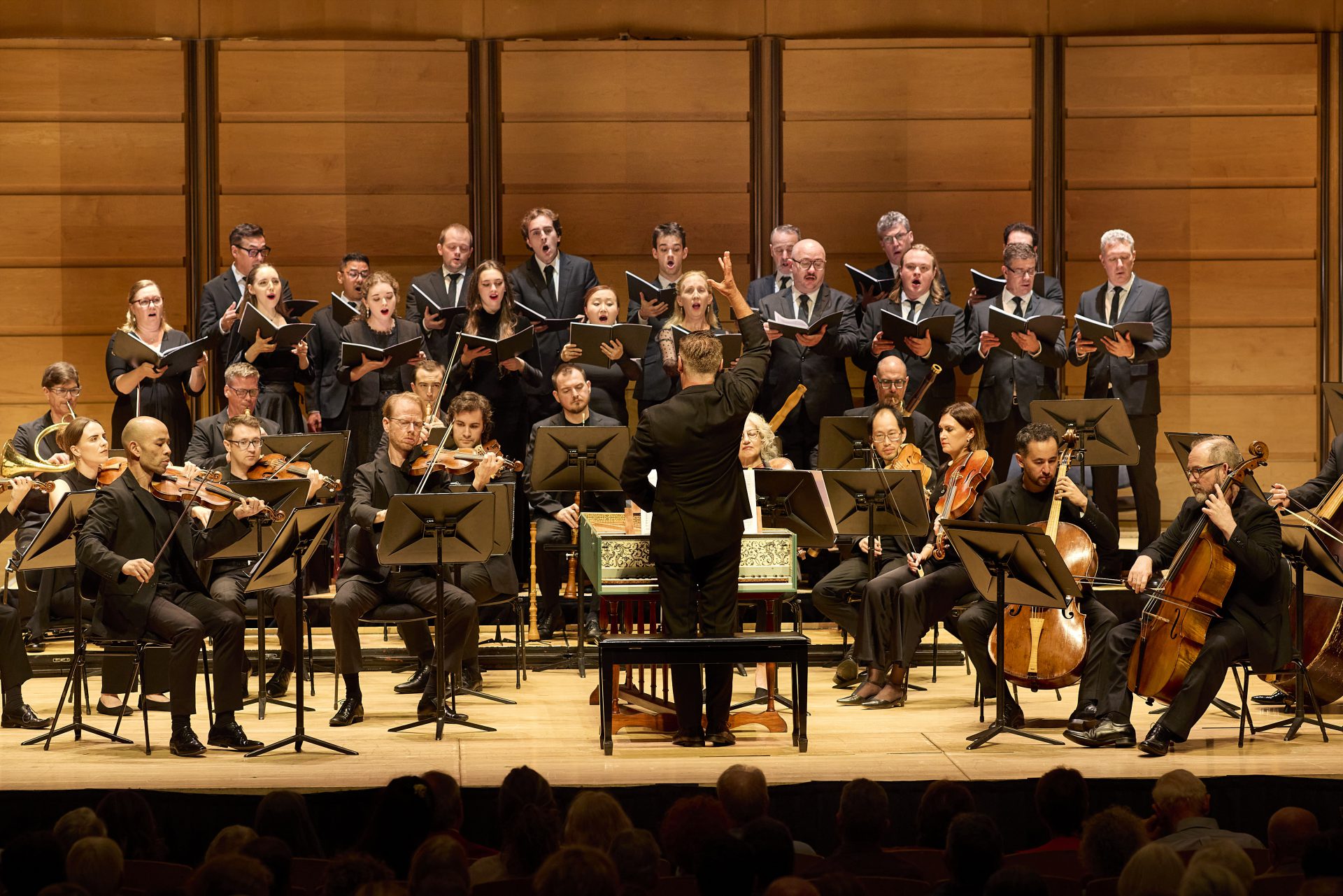
The great masters of the Baroque were connoisseurs of the choir.
One has only to think of Monteverdi and San Marco’s, Vivaldi and the Ospedale and of course Bach and the Thomanerchor. Each knew how to master the power of the choir. In fact, much of Baroque music centred on the spoken word. After all, one goal of instrumental performance practice was to emulate the human voice, to master articulation, and to perfect the art of rhetoric.
It’s no surprise that the first half of this celebration of “Choral Splendour” was dedicated exclusively to the work of Bach. Not all of it was choral.
Wachet auf, ruft uns die Stimme is famous for its more pastoral setting in the chorale prelude, BWV 645. The same hymn was developed in a cantata, BWV 140. Here, the rhythm has a decidedly Lutheran perseverance. The dotted rhythms march, almost jab, forward, and build up gradually. The choir did well, but the altos stood out. The sopranos brought out the cantus firmus well.
Herz und Mund und Tat und Leben, BWV 147, was next. The mood was similar. The trumpets were pleasingly accurate – no mean feat. The voices layered well, but still maintained a sense of independence. At times it seemed the bass voices were too diffident.
Of greatest interest was Bach’s Wir danken dir Gott wir danken dir, BWV 29. It features an intricate opening instrumental sinfonia. That itself is not striking. Bach employed the same Italianate technique in one of his earliest cantatas, Christ lag in Todesbanden, and in many of his later cantatas, like Tritt auf die Glaubensbahn and the delightful French overture announcing Jesus’ entry in Jerusalem on Palm Sunday in Himmelskonig, sei Wilkommen.
What is striking is the prominence given to the organ. The organ part was probably performed by Bach himself, who was renowned in his time more as an organist than as a composer. The part is a transcription of Bach’s partita for violin in E major, which is based on an ascending E major scale.
Andrew Dyer had the orchestra play at a pace that was bound to give the organist vertigo. Heidi Jones rose to the challenge. On a continuo Klop organ, it is easy for a busy solo played at that speed to sound like an indiscriminate wash of noise. It did not. The melody – not to mention the beauty and seamlessness of some of Bach’s key-changes – could be discerned clearly. Still it must be said, the piece lost some of its majesty at this speed.
The effect was more pronounced in the choral opening. Somehow, the tempo was even brisker here. Discerning audiences would have recognised similarities with Bach’s later Donis nobis pacem, which is the grand, sprawling, denouement to the Mass in B minor. Both are usually thought of as slow, contemplative works. Not so here.
Interposed among the choral works was Bach’s Concerto for two violins in D minor, BWV 1043. It was a good choice, in part because it leavened the heaviness of some of choral masterpieces, and in part because it betrayed all the same characteristics – external majesty, but an intricate internal order. Again, the tempo was fast. At times too fast, especially for the bass strings. The second movement featured an extended dialogue on violin between Shaun Lee-Chen and Ben Dollman. There was a tendency to play inegales, which was slightly off-putting but which worked on the whole.
The second half opened with Telemann. The Overture from his Overture in D major TWB 55:d18 is one of his most well-known. It has a particularly pompous opening. Fast pace worked well here. Especially in the B-section. Dynamic variety was on full display in the orchestra here.
Heinichen’s Concerto in F major, S 234 is also well known. It gives unusual prominence to the corni da caccia. This appears to have been a German preoccupation. We can see it in Bach’s first two Brandenburg concertos, for example. There was some slips, but that is only to be expected on an instrument as difficult as the horn. The third movement was the most interesting. The strings are plucked. All is mute. The scene is set for the flute. Mikaela Oberg on flute played expressively with accompaniment on oboes.
Then came Handel’s coronation anthems. The third, The King shall rejoice, is one of his more developed anthems. But of course the highlight was Zadok the Priest. The choir was at its best here. The effect was so powerful that one could hardly think that this was a choir of only 18-strong.