An Easter Passion.
Easter would not be Easter without a Passion. Bach’s St John Passion was first performed for the Good Friday Vespers in 1724, Leipzig. There are several versions. What marks out the St John Passion from the St Matthew, and perhaps the St Luke, Passions is a certain intimacy. We hear relatively little from Jesus. He is characterised as a figure of great pathos. The arias are fewer, but they are more subtle, more heart-felt. Primacy is given to narrative. Recitative abounds. And the dramatic pace is unrelenting.
Despite the intimacy of the St John Passion, it was performed in the Sydney Opera House, albeit with a strong choir.
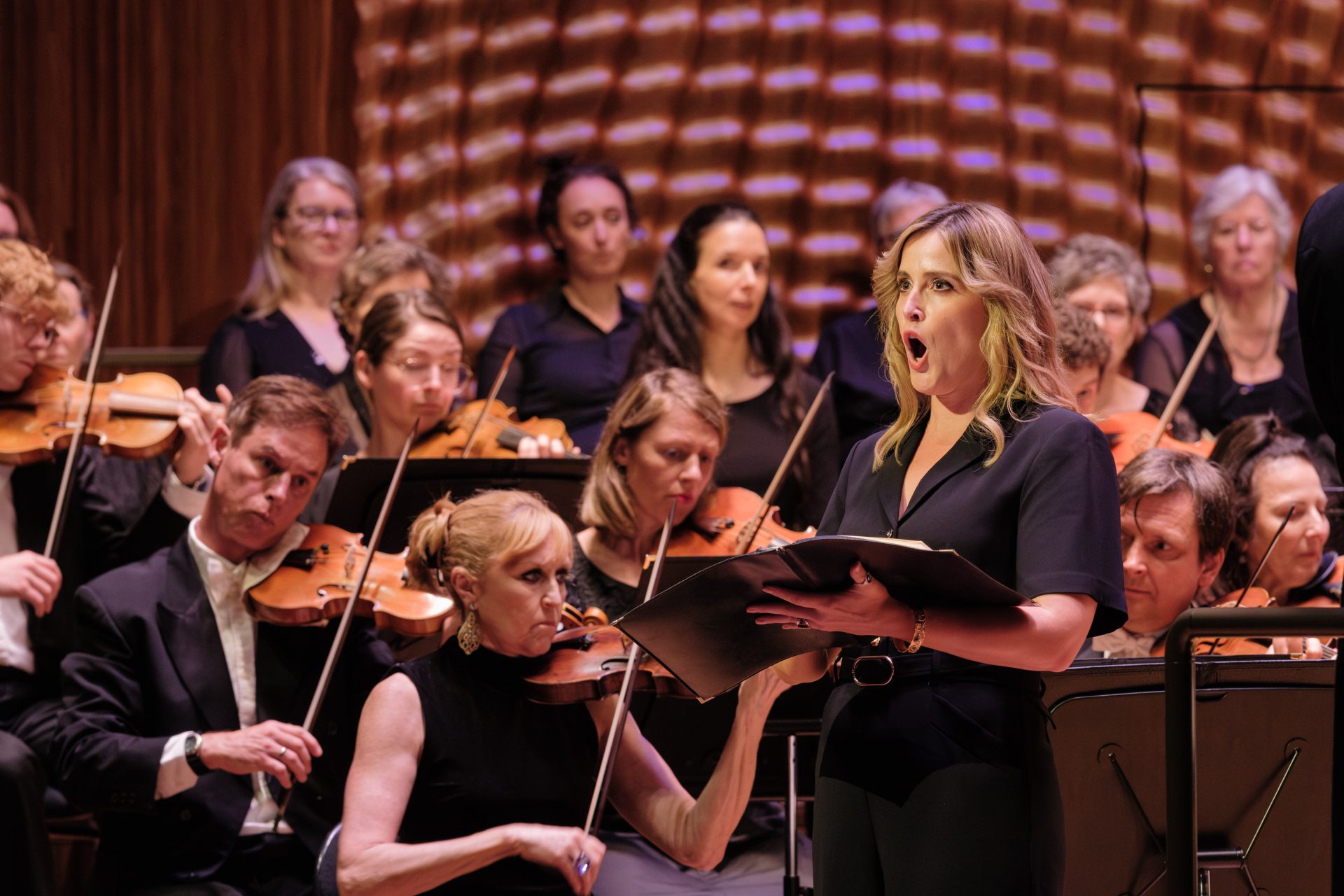
Under the energetic direction of Bret Weymark, the Sydney Philharmonia’s Symphony Chorus and Baroque Orchestra assembled the best of early music’s soloists – Penelope Mills as soprano, Ashlyn Tymms mezzo-soprano, Michael Petruccelli as tenor, Timothy Reynolds as tenor evangelist, Christoper Richardson as baritone Jesus and of course Andrew O’Connor as baritone Pilate.
The opening chorus – Herr unser Herrscher – has the effect of a wintry blizzard, with the ominous winding string passages, the climbing dissonances on oboes (the instrument most redolent of the human voice), and the piercing shrieks of “Herr”. It was performed here at a sprightly pace – more dance than tombeau. A times it seemed the flutes and oboes were off-piece and the tenor somewhat diffident. Weymark had the choir sing the third “Herr” sotto voce which gave the effect of a resigned plea and a premonition of the tragedy that was to follow.
Fast tempi was the style of the day. The Von den Stricken was played at breakneck speed. The text speaks of unbinding from the snares of sin. Bach has the sinuous oboe lines entangled in one another in close canonic imitation. He did the same in the more sinister “Wer Sünde tut, der ist vom Teufel” in BWV 54. The entanglement was largely lost in the rushed tempo. Still, Tymms managed to keep up and sang with great control. Rushed tempo fit well in some, but not all arias. The Ach mein Sinn was performed at a rollicking tempo, but after all the aria is rollicking.
Then came Mills’ Ich folge dir gleichfalls. Her voice was light and tended to waft effortlessly above the audience. The continuo depicts the perseverance of the faithfuls’ footsteps – think back to Tritt auf die Glaubensband – with Mikaela Oberg’s deft playing on flute capturing something of the lightness of “die freudigen Schritten”. Weymark had Mills linger on a delightful little ritardando on “mein licht” as the orchestra picked up pace, which was an effective play on tempo.
By this time it became apparent that Reynold’s honey-timbred voice was well suited to the role of the Evangelist. It was animated without being emotive. Articulation was mastered. He mastered the pregnant pause. What was missing, however, was admonition. It must not be forgotten that the evangelist sang from the pulpit. Still, Reynold’s control and dynamic variety was on full display in the meandering “weinete bitterlich”.
The second part begins with the powerful “Chritus der uns selig macht”. It is meant to blow the audience away, with its stabbing repeated notes and its bleak modal style. It lost much of its majesty at a quickened tempo. But what it did gain was variety. “Macht” is sung with might. And Weymark has the choir sing the final line at a slower, contemplative pace, ending as it does on something of a question mark.
This is the point at which the dramatic pace begins to thicken. The recitatives are punchier. Choruses abound. The choir turns from spectator to bloodthirsty mob. The riotous cacophony of “kreuzige”s was a moment to behold.
There was much zealous strumming on the Baroque guitar in the choruses, which was strangely accentuated by the Opera House’s acoustics. The Betrachte looks back to the stillness of the first part. We have solo bass voice, two violins, and the silvery tone of the lute. This arioso was well suited to Richardson’s voice.
With the Erwage, we are plunged into the quieter, more contemplative, soundworld of the Baroque. Hence why Bach calls for the mellow earthiness of the viola da gamba. It is hard not to notice that just as the text speaks of a “regenbogen”, the music centres on an arched, symmetrical, motif which rises and falls in equal measure.
It is a tale as old as the Renaissance that when the text speaks of “gesetz” of “bund” (think back to BWV 106), the muse must give us tight counterpoint. Canon, after all, means law. This we had, in the “Wir haben ein Gesetz”. Again, the tempo was fast. The effect was more slapstick than sinister. There was a tinge of musical theatre in all this. That is no bad thing. The truest of tragedies betray an element of the comic.
As in most Passions, there comes a point when the text calls upon the composer to conjure up the earthquake that accompanied Jesus’ crucifixion. In the original 1724 version of the St John Passion, that point was the aria, Himmel Reisse. In the later version, with which most audiences are familiar, we have Anthea Cottee despatching a fiendishly difficult, almost percussive, descending line on the cello. David Drury followed suit on continuo organ, quite literally pulling out all the stops – or at least most of them.
The highlight was Mills’ performance of the heart-rending Zerfließe, Mein Herze. The aria is devastating in its simplicity. Bach calls for the earthier oboe da caccia. The fear of most audiences is a soprano who screeches in an attempt to convey anguish in the higher registers. Mills’ performance was delightful, her articulation careful and her dynamic variety sensitive. There were light tremolos on “tot”. Much the same, of course, could be said of Oberg’s performance on flute.
Most ancient Greek dramas close with a chorus imploring the audience never to forget the plight of the tragic hero. So we have the closing of Purcell’s Dido and Aeneas – “keep here your watch, and never part”. It speaks of cherubs with drooping wings. So too we have Ach Herr, lass dein lieb Engelein. Here, Weymark and the choir mastered the intense buildup to the impassion plea – “Herr Jesu Christ, erhöre mich” – followed by a pregnant pause, and softened with a hushed closing. This was a thoughtful ending.