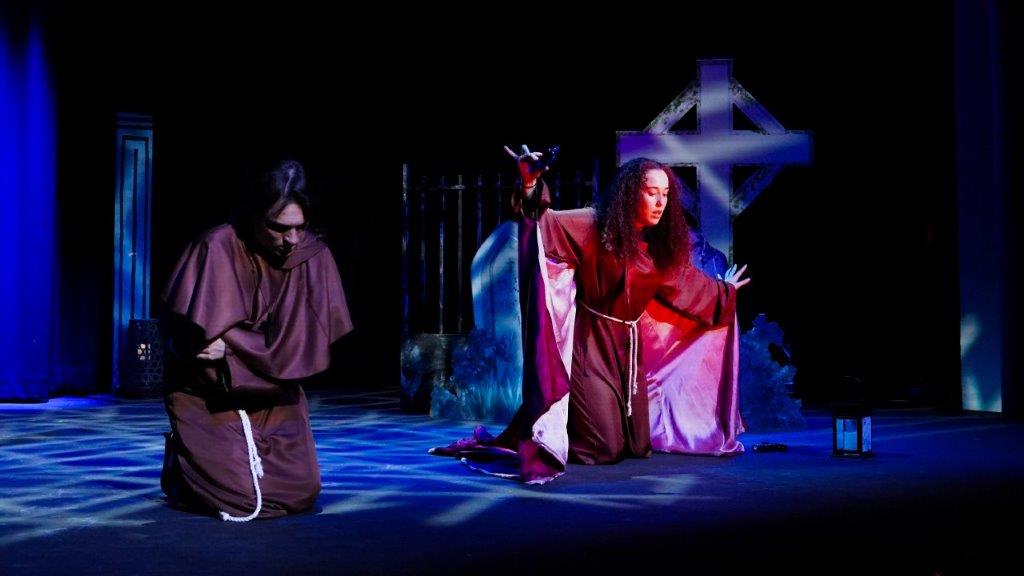
As the audience was transported by the Rockdale Opera Company to old world Madrid from the Art Deco confines of Rockdale Town Hall, there were all the makings of a gothic horror story: satanic rituals, lust, and violence.
This was the world premiere of The Monk, directed and composed by Dr Steven Stanke; it is his first opera, based on Matthew Gregory Lewis’ 1796 novel of the same name.
The Monk begins in Madrid, where Ambrosio (Daniel Verschuer) is skilfully preaching to his congregation, including the young Antonia (Galatea Kneath) and her aunt Leonella (Camilla Wright). Taking the warm reception of his sermons too deeply to heart, he is convinced of his own moral strength and piety, believing himself quite immune to the earthly temptations of his supplicants. However, when his fellow monk ‘Rosario’ confesses to actually being a woman named Matilda (Elizabeth Cooper), Ambrosio is drawn into a downward spiral of consequences marked by insatiable desire and violence.
This opera was exceptionally well cast. While the cast of this chamber opera was small, every performer rose to the challenge remarkably. Both Verschuer and Cooperbrought fantastic stage presence and gravitas to their performances; given the complexity of their characters’ development, this was “sink or swim” territory for the production, and they excelled. Their voices were agile, thrusting the audience into the souls of Ambrosio and Matilda respectively. While both Kneathand Wright were more limited by their characters’ simplicity, they distinguished themselves in their respective performances, soaring with a radiant soprano that filled the hall. In Kneath, the youthful innocence and moral clarity of Antonia shone through brightly; in Wright, the protective defiance resonated and was deeply felt.
While I thoroughly enjoyed the music composed by Stanke, the work suffered somewhat by being composed in the chamber opera genre. There are unavoidable trade-offs when keeping a performance to a tight 90 minutes, including limiting the breadth or depth of the source material. While there were some very sensible cuts to the number of characters and subplots, much material of importance was lost. While it is understandable that one writes for your intended audience, the exclusion of confrontational elements from the source material – such as murder and sexual assault – greatly diminished the didactic power of its source material. Indeed, the production came off more like an indecent Romeo and Juliet than a true descent into depravity, corruption, and brutality. However, by limiting the work’s breadth to promote depth, Stanke made the preferable of two inevitable but unfortunate choices. The writing still managed to convey a message about the danger of unfettered desire, even if it was not entirely as deep or convincing as the original novel.
The production elements were well handled. The costumes by Sandra Tutt and Megan Chalmers were sumptuous and delightful, greatly assisting in transporting the audience to the world of old Madrid. Similarly, the lighting was precise in establishing the appropriate atmosphere and tone. The set, coordinated by Glen Stelzer, was suitably minimalist and clever, particularly during the ritual scene in the graveyard.
Ultimately, while the constraints of the chamber genre occasionally stifled the source material’s darkness, the Rockdale Opera Company has delivered a vocally stunning premiere that proves the enduring power of gothic storytelling.
Note: cover image (c) Ben Gallion.