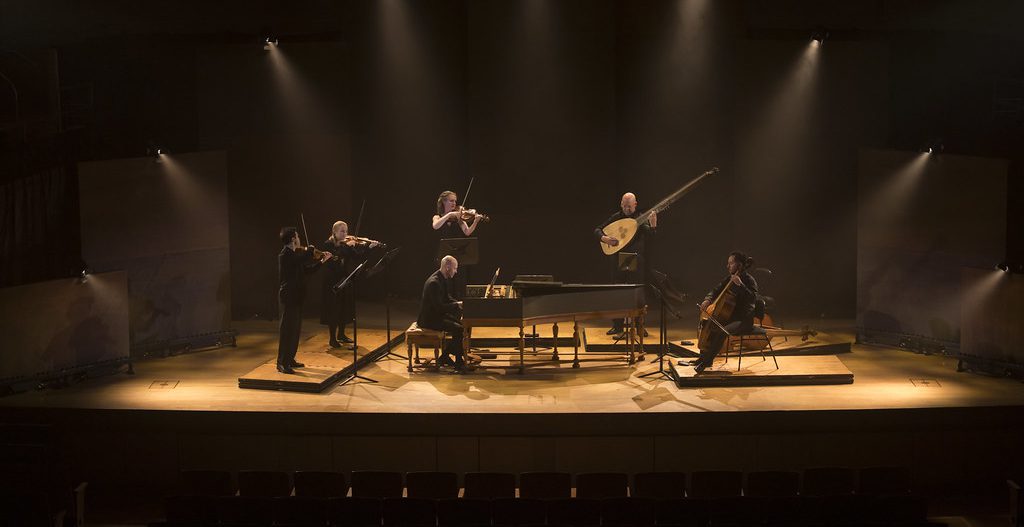
A baroque soiree.
Pinchgut Opera has an affinity for those understudied corners of the Baroque. Even their performance last year of Handel’s Messiah was no exception, reviving as it did the original 1742 Dublin version.
Telemann’s oeuvre is replete with understudied corners. In large part, that is because of his sheer industry. So relentless was his pace of production that he surpassed even Bach in musical output.
The two were close friends. Telemann was godfather to most of Bach’s surviving children. The two directed the local Collegium Musicum – a motley group of musical students in that grand old university town, Leipzig. Gottfried Zimmerman, an enterprising coffee shop owner, hosted them for concerts in the garden of his coffeehouse. This was bound to attract custom and it did, so much so that subscription concerts shortly followed.
Zimmerman’s coffeehouse was the locus of this concert. The great names of the German Baroque – Bach, Telemann, Fasch, Graupner, Pisendel – all performed there. That being so, it is a shame that the stage was so plainly set. Perhaps we must look forward to Pinchgut’s production of the Coffee Cantata later this year for more creative staging.
As with the Collegium’s performances, the concertos here were performed one-to-a-part. That gave a domestic, intimate, effect redolent of a small soiree.
Telemann’s Sonata a 4 in A major, TWV 40:200 begins with a very short affettuoso which quickly morphs into a sprightlier Allegro. Dynamic variety was on full display in the closing Vivace, when the entire ensemble moved seamlessly from pianissimo to forte.
Next was a lute concerto by Johann Friedrich Fash – another participant in Leipzig’s Collegium Musicum. A lute concerto must have felt experimental for its time, and it still seems so. Simon Martyn-Ellis performed on the gallichon, being the latest acquisition of the Orchestra of the Antipodes. The concerto was pleasant enough, and had all the usual Baroque idioms. Although the ensemble did its best to perform sotto voce, there was still little room for the gallichon to be heard. Even the harpsichord with the buff stop was more prominent. But there was something to be said for playing quiet music in a modern recital hall – the Baroque soundworld was infinite in its largeness as in its softness (think of the clavichord).
Telemann’s Sonata a 5 in E minor TWV 44:5 seemed to look back in time. The opening Adagio sounded more like Nicholas Bruhns and the mystical North German Abendmusiken than the courtly Baroque of Telemann. It was at this point that Rafael Font Viera swapped the usual viola for the larger and more sonorous tenor viola. Pippa Macmillan, too, was performing on the violone rather than the usual, larger, Baroque double bass. Like most members of the viol family – whose sloped shoulders are a distinctive family trait – the sound is earthier.
Matthew Greco’s expressive powers were on full display in Bach’s Violin Concerto in A minor, BWV 1041. Ornamentation was abundant but never forced, and some of the notes were sustained with great finesse. The concern of the Baroque – and not just Baroque music – was with disciplined embellishment, and that was on full display.
Then came two more of Telemann’s sonatas – one in G minor and the other in B-flat major. The first had all the hallmarks of tafelmusik – the sort of divertimenti designed to be played under, not over, a conversation. This was not music that commanded attention, and perhaps not everything of vintage is worth reviving. The second was more eventful, with a sunny ending and a busily fugal second movement.
Of course, the main fare was Bach’s Harpsichord Concerto in D minor, BWV 1052. Even though Bach was wont to force new instruments (like the lautenwerk) upon his local instrument-maker, we don’t often think of the stolid old Thuringian as an innovator. But a harpsichord concerto was a first for its time. For too long the harpsichord had been seen as a continuo instrument in public, or a solo instrument for private consumption. Here it took centre stage. This experiment was more successful than Fasch’s; to this day we have piano concertos.
The concerto begins dramatically enough. Everything is in unison. There were some slips in synchronisation within the ensemble with the rapidly descending chorus of thirds in the beginning. Helyard’s discreet conducting from the keyboard helped to assemble the ensemble. Things picked up quickly. Curiously, Erin Helyard on harpsichord did not engage the full registers of the Ruckers harpsichord until the latter half of the first movement. There were doubtless considerations of profound musicality behind that choice. For one thing, it helped audiences appreciate the diverse tonal qualities of the harpsichord – often mocked for lack thereof – and this was done by often alternating between manuals to give a delicious echo effect. But the result was an unusually nasal start.
It is hard not think that all of this started off as a violin concerto and was remodelled after the fact. The Adagio has all the hallmarks of a lilting slow-movement with an almost operatic aria for what must have been obligato violin, and now harpsichord solo. The highlight of the third movement was the broken chords which descended upon the audience like a thunderbolt. By that time, the 4-foot register had been unleashed in all its glory.