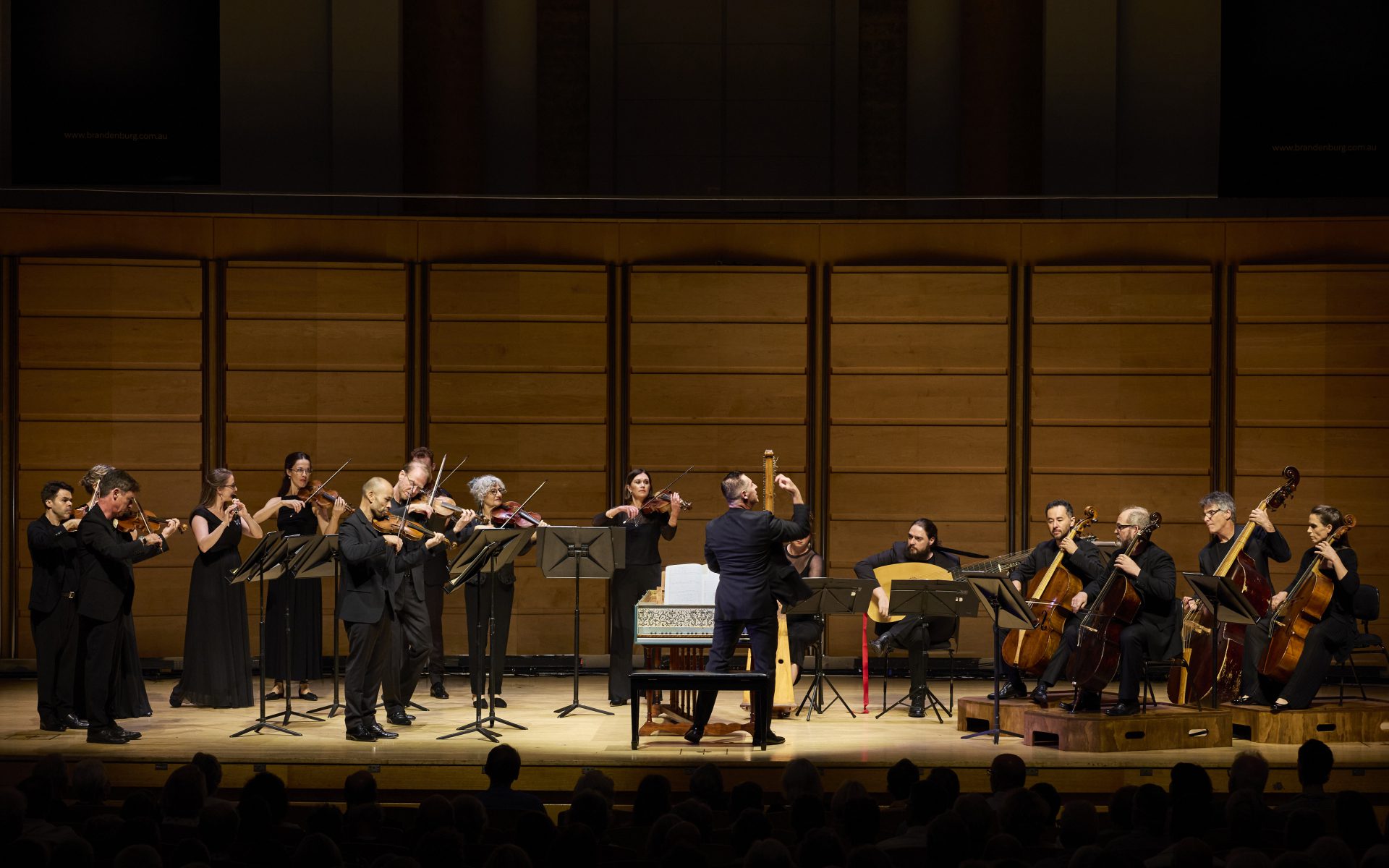
A baroque exhibition.
Handel is always a great way to open. His Concerto Grosso in G major Op 6 No 1 HWV 319 begins on a sprightly note but soon descends into the darkness of E minor. The mood is at once stately and brooding. The lilting solo motif was performed expressively by Shaun Lee-Chen. The orchestra did well in navigating subtle changes in dynamics. Then the whole thing breaks out in a rustic dance not unlike Vivaldi’s Concerto alla Rustica. The whimsical motif which ascends step-wise looks forward to Mozart. The Adagio really should have been marked Grave by Handel. It is almost devastating in tone.
Next was Marcello’s famous Oboe Concerto in D minor. Bach paid the highest compliment to this piece by transcribing it for keyboard. It has all the hallmarks of the Italian high baroque – elegant, expressive in effect, but simple in design. Adam Masters on oboe showed us all how he has mastered the variety of expression on the oboe, from articulation to subtle vibrato.
An exhibition of the best the Baroque has to offer would not be complete without at least one movement from Bach’s six Brandenburg concertos. Thankfully, we were given the third and the fourth concertos. Those were informed choices. The sixth is pleasant but too studied. The first two are very German – featuring as they do the traditional hunting calls on trumpet. The third and fourth fit nicely into what went before, and what was to come, in this concert.
The fourth concerto was performed first. As usual, Mikaela Oberg and Melissa Farrow excelled on recorders. Bach seemed particularly fond of pairing recorders; he had experimented with it in one his earliest compositions – the Actus tragicus. The pairing particularly stood out in the plaintive second movement. The third movement was full of imitation between sections of the orchestra but was perhaps performed too fast for the full colours to come out. Still, a heightened tempo made Lee-Chen’s tremolos and double-stopping even more brilliant.
The third concerto is a veritable festival for the strings. The question for every performer is what to make of the cryptic second movement, a bare Phrygian cadence of two notes. Paul Dyer’s answer? Superimpose the aria from Bach’s Goldberg Variations. That choice had a delicious symmetry to it, not least because Erin Helyard was performing it at precisely the same time, in the Melbourne Recital Hall. The two notes came in in the final bar of the aria. It worked well. The third movement is by far the busiest and the most complex. The theme is tossed around the orchestra, although at times it seemed the violins were too fast for the bass.
Pachelbel’s canon has become something of a meme. When it is placed in historical context, and when life is breathed into it with historically informed performance practices, it is clear that that should not be so. With Nicholas Pollock on Baroque guitar, and vigorous continuo realisations by Dyer on harpsichord, it gave the impression more of a pleasant chaconne, like a Zefiro torna, than a device to torment the cello.
Johann Joachim Quantz was a flautist who had the good fortune of being in the employ of a fellow flautist, Frederick the Great. His treatise On Playing the Flute is a valuable insight into Baroque performance practices on the flute. He ought to be more known. The concert program prepared us for his Concerto for Flute in C minor, QV 5:38, but what was in fact performed was one movement from his Concerto for flute in G major, QV 5:174, which was performed delightfully by Melissa Farrow.
It was all rounded off with a rustic peasant dance, the famous La Follia. This time, it was Vivaldi’s setting. The tempo built up gradually. Lee-Chen and Ben Dollman had some fiery exchanges. Scales were despatched with ease, and in the space of a breath. It closed off with a very Vivaldian cadence, performed as a series of shimmering tremolos.