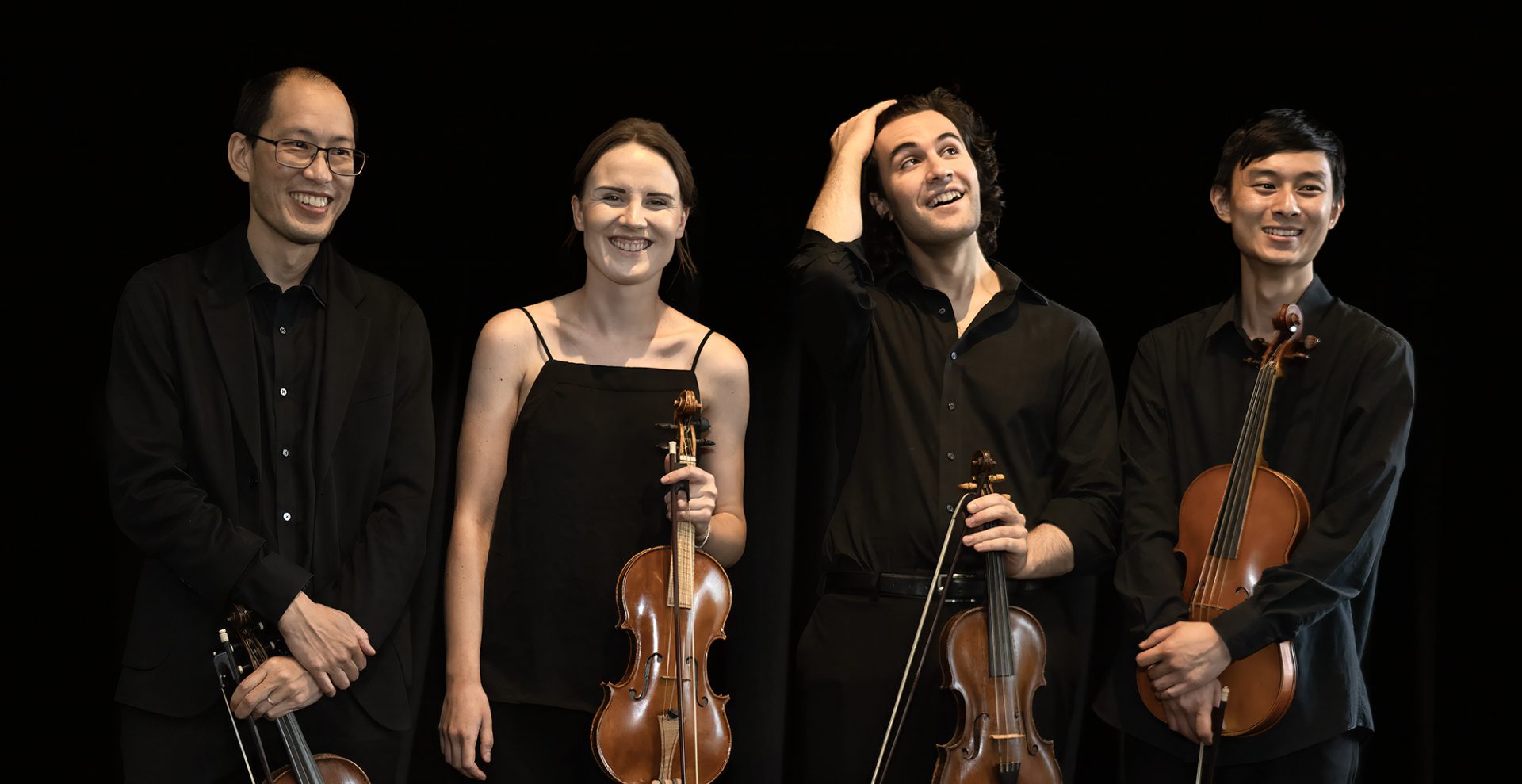
The first of Salut Baroque’s concerts in 2026 was as cosmopolitan as ever. It traversed the French, the German and the Iberian.
But first the English. This reviewer was first transfixed by Christopher Tye’s In Nomine ‘Crye’ in 2023 when Jordi Savall and Hesperion XXI performed it in the Sydney Opera House to great acclaim. That was with a viol consort. This time it was with Baroque woodwinds. Performers are faced with an interpretative dilemma. Is the ‘crye’ a pious lament, or is it the ‘crye’ of the merchants in England’s bustling markets? Savall favours the former; this ensemble the latter. In part, that is because of the choice of instrument – a viol is predisposed to the long, drawn-out plaint. The faster tempo brought out the underlying ‘In Nomine’ cantus firmus, performed by Alicia Crossley on bass recorder. That very Renaissance of motifs – a sudden shift in metre – was a moment to behold as the recorders danced their way to the tierce de picardie.
Telemann was famed for perfecting the French musical style and bringing it to home to the German states. He appeared to prefer the “Ouverture-Suite” to its Italian counterpart, the concerto grosso. His Ouverture-Suite in D minor TWV 55:d3 features characteristically French dances – Courante, Loure and Menuets. We have also the Canaries (from the Canary Islands) and strikingly, the quintessentially English ‘Hornpipe’ which features in many Handel concerti. As can be expected, the last two were the most energetic.
Cristoforo Caresana’s La Tarantella was born of another soundworld. We know we are in the territory of rustic chaconnes when the piece begins with percussive strumming, by George Wells on baroque guitar. John Ma’s feverish use of vibrato matched the rustic feel very well.
Then followed a set of variations on the famous tune Greensleeves. It seemed like a feat made for Sweelinck, that old master of the art of variation who toyed with such contemporary English tunes as Fortune my Foe and Flow my Tears. But those stars never aligned. Here we had a set of 10 or so variations made for a recorder quartet. Each was pleasantly performed.
Telemann’s Concerto in D major for 4 violins is an interesting piece with a curious arrangement – for 4 violins solo, sans basso continuo. The first Allegro was contrapuntally heavy but incredibly light and sunny, although at times it seemed the bows were being pressed too hardly on the strings. The Grave had more than a hint of Couperin’s “L’apothéose de Corelli”. It was delightful.
By the end, it became clear that the star of this show was Anna Stegmann on recorder. In case it was not clear by then, it was certainly became obvious in Fiorenza’s Concerto in F minor di flauto, 3 violin, violetta, violoncello e basso. This is a strange, almost idiomatic, composition. It is episodic, has wild turns of character and strange modulations. Apart from her evident dexterity in the faster movements, Stegmann’s prowess was on full display in the Largo, where she showcased the whole gamut of rhetorical expression on the recorder, from subtle vibrato and beyond.