From Italy to France to Adelaide.
Like Carissimi, Rossi was renowned for exporting the seconda pratica from Italy to France. In particular, there was the Italian favola in musica, which transformed itself into the tragedie lyriques over which the imperious Lully later enjoyed a monopoly.
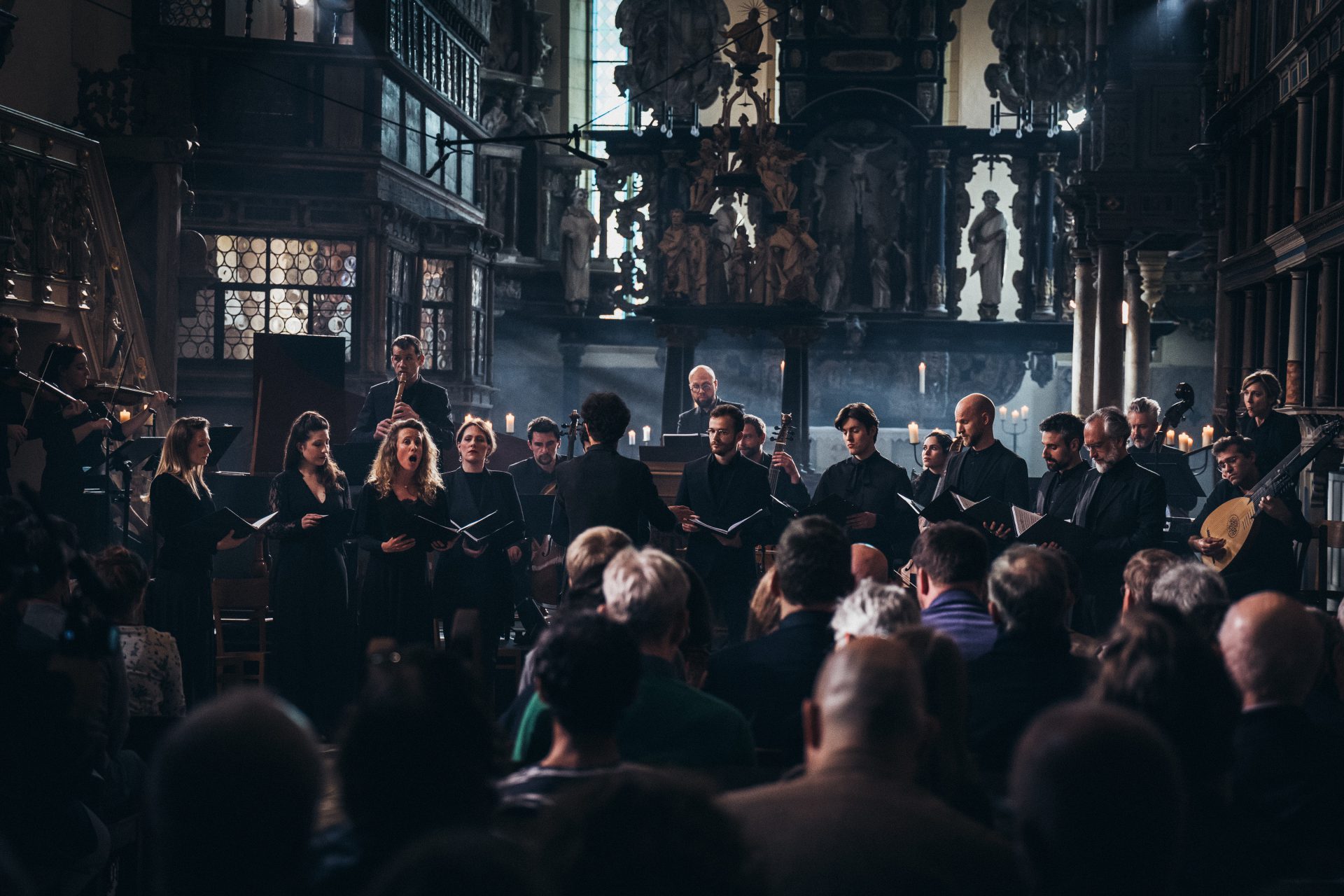
Ensemble Pygmalion has established itself as a leading early music ensemble and choir in France. They touched down in Adelaide for this year’s Adelaide Festival, performing Bach’s motets and Monteverdi’s vespers, both to great acclaim. Their final showpiece was Luigi Rossi’s Orfeo. It is one of the earliest opera ever composed, and it is no coincidence that the first – written by Monteverdi but now lost to time – treated the same subject.
The stage in the Adelaide Town Hall was bedecked with several harpsichords and one continuo organ. Raphael Pichon conducted, centre-stage, from one of the harpsichords. The audience had the benefit of surtitles splayed in front of the Town Hall’s magisterial pipe organ.
Drawing on the best of Renaissance drama, the hallmark of any early opera is a prologue. But this rendition jumped straight to the tragic overture.
The opening scene has Eurydice (Julie Roset) and her father Endymion (Tomas Kral) prepare for her wedding to Orpheus (Xenia Thomas). The Adelaide Town Hall was an unfortunate choice of venue for an opera, not for staging but because of its acoustics. The richness of Kral’s voice was largely lost to the vastness of the theatre. Alex Rosen had a commanding bass voice as Pluto, and mastered the Monteverdian art of the goat trial, which was used to evoke anguish.
In the first Act, as in each of the successive Acts, Roset’s voice shone as Eurydice. Her voice tended to waft effortlessly above the audience, never strained and never screeching. That is no mean feat. Rossi gave Eurydice recitatives and arias traversing the entire gamut of the human condition – from the splendour of sleep, to the fury of unrequited love, and the joy of dance.
The audience does not get to see Xenia Thomas as Orpheus until well into the piece. Thomas emerges, resplendent in white blazer, with an equally resplendent recitative. Thomas’ coming-together with Roset toward the end of the second scene was something of a Pur ti miro moment.
Blandine de Sansal unleashes her fury as Aristaeus. Her performance was consistently engaging and persuasive. Her fury in the third scene of the first act was matched, curiously, by viols, whose earthy timbre gave a strange humanity, even pathos, to Aristaeus’ diatribe. The viols were a highlight throughout this performance.
Again in true Renaissance style, the drama picked up in the next scene with rural, almost bacchanalian, revelry. Samuel Boden appeared as the vain Momo, the wedding ceremony’s gadfly. His torments were grounded on a chaconne which recalled Monteverdi’s Zefiro torna.
It would not be an early opera without a bit of cori spezzati. The ensemble made good use of the space in the Adelaide Town Hall. Parts of the choir were relegated to the upper gallery. Madrigals rained down upon the happy spectators below until the plot thickened. Omens appear. Augurs forewarn. The choir descends into dark, clashing, dissonance, begging for “pieta” from the gods.
It is clear that this choir mastered the art of dynamics. This reviewer was first transfixed by Ensemble Pygmalion upon hearing their rendition of the closing “Amen” of Monteverdi’s Ave verum corpus, which wavers, feverishly, between pianissimo and fortissimo in the space of a couple bars. The same spine-chilling technique was deployed here, to great effect.
The second Act opens with another great Renaissance trope, the motif of the babbling old woman. One has only to think of the text of Willaert’s madrigal, Vecchie l’etrose, to see that the subject of this theme was looked upon with equal parts scorn, derision and mockery in Rossi’s time. Dominique Visse excelled in the role, both dramatically and musically.
Music is a theme that runs throughout this opera, based as it is on the life of a Thracian bard. The second Act is strewn with little vignettes sung from the gallery. Eurydice breaks out, in a very meta way, into “song”. She sings of “my beloved”. In the very beginning, the father sings of the “splendour” of his daughter. When Eurydice falls asleep in the pasture, the choir in the gallery sings the haunting “Dormite begli occhi”, with its jarring dissonances flashing suddenly like lightning. This madrigal was the highlight of the night. When Eurydice is bitten by a snake, the music devolves into a fiendish series of ever-falling chromaticism.
The highlights of the third Act were the forceful triad of the Fates, Orpheus’ rage against them, and the delightful sotto voce introduction of the violins in the second scene.
This was early music at its finest.