Rediscovering a mystical masterpiece.
Before Bach, there was Schutz. Exactly 100 years before, to be precise.
He brought with him the lush lyricism of the Italian seconda prattica into a Germany darkened by the death, devastation and misery of the Thirty Years War.
Like Bach, he wrote largely sacred music. Like Bach, he lightened the sacred with the best of the profane. Like Bach, in his latter years he gave us his musical testament. Bach had his Mass in B minor. Schutz gave us the Schwanengesang.
In it we can hear the seductive dramatism of the Italian madrigal, the severity of the German motet, and the deep mystical, even quietist, ethic of much early Lutheran music.
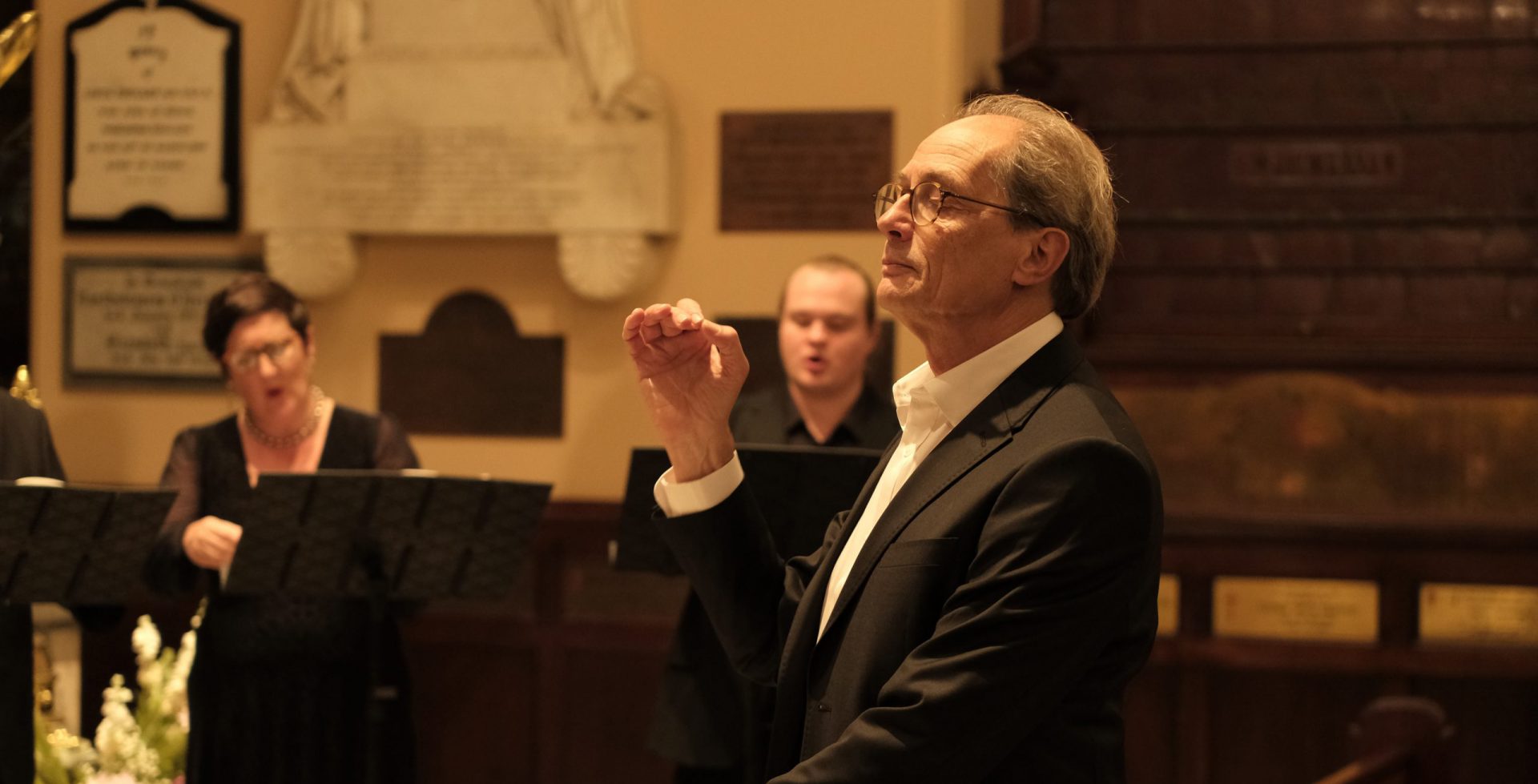
Before the altar in St James’ Church, The Song Company was divided into three parts. Prominent were two SATB sets facing each other – somewhat redolent of the double-choirs of Monteverdi’s San Marco, not by accident. Behind them were added choral forces. Those forces swooped in during the poignant endings in each of the 12 stanzas. One is surprised to read on the program that the supporting choir consisted of “emerging artists”. Their voices were full-bodied and impressive.
It is no surprise that Schutz chose to set Psalm 119 to music. Midway it beckons the muse: “Thy statutes have been my songs in the house of my pilgrimage” (“Deine Rechte sind mein Lied in meinem Hause”). Lutheran composers were wont to draw on musical allusions in the psalter, starting with Luther himself. Bach famously cherished a copy of the Bible which had as its frontispiece the image of the Levites, with their lyres and shawms.
Added to that is a beautiful symmetry which can be attributed to Schutz’s own design. He closes each section with the lesser doxology: “Ehre sei dem Vater und dem Sohn und auch dem Heiligen Geiste”.
The opening intonation in each section is sung with bell-like clarity by tenor Timothy Reynolds. Schutz evidently revelled in the opportunity to give thirteen renditions to the doxology. Each had its own flavour. In each, the tenors especially shone, although some parts seemed a bit zealous at times. Each section of the choir built up dramatic effect with full force and might. In each part, the soft sustain of the altos was impressive. In some, like the eighth, the closing doxology is pared back.
The Italian mastery of word-painting which Schutz brought back with him from Venice was on full display in some of the most vivid parts of the text. On ewigkeit we have prolonged notes and an ever-so-gradual buildup. On ich wandle frohlich (“I wander happily”), Schutz shifts the metre, and lightens it all with the briefest of jigs. On tausend stuck (thousand voices) he gives us rich polyphony with canonic imitation.
The choir seized upon all this with ease. Conductor Roland Peelman has the choir sing “niederdrucken” with sharp, almost biting, articulation. “Und schreie” was piercing, in the most pleasant way possible. “Eitel Luge” is despatched with short shrift – like the “falsche Zungen” of Bach’s Geduld.
One difficulty with German motets of this period is that they can often lack rhythmic variety. At times they can seem like an arduous monotony, in moto perpetuo. The fourth could have done with a bit more variety. Some of the most poignant parts of the text – “von ganzem Herzen” – were sung in the same breath as everything else.
On the other hand, the twelfth is the closest one gets to madrigal. It is episodic and full of rhythmic variety. Recalling its opening words, Jachzet dem Herren, it unfurls into something bright and magisterial. The sunny organo pleno accompanying the choir’s high-point at “Fur und fur” was a moment to behold.