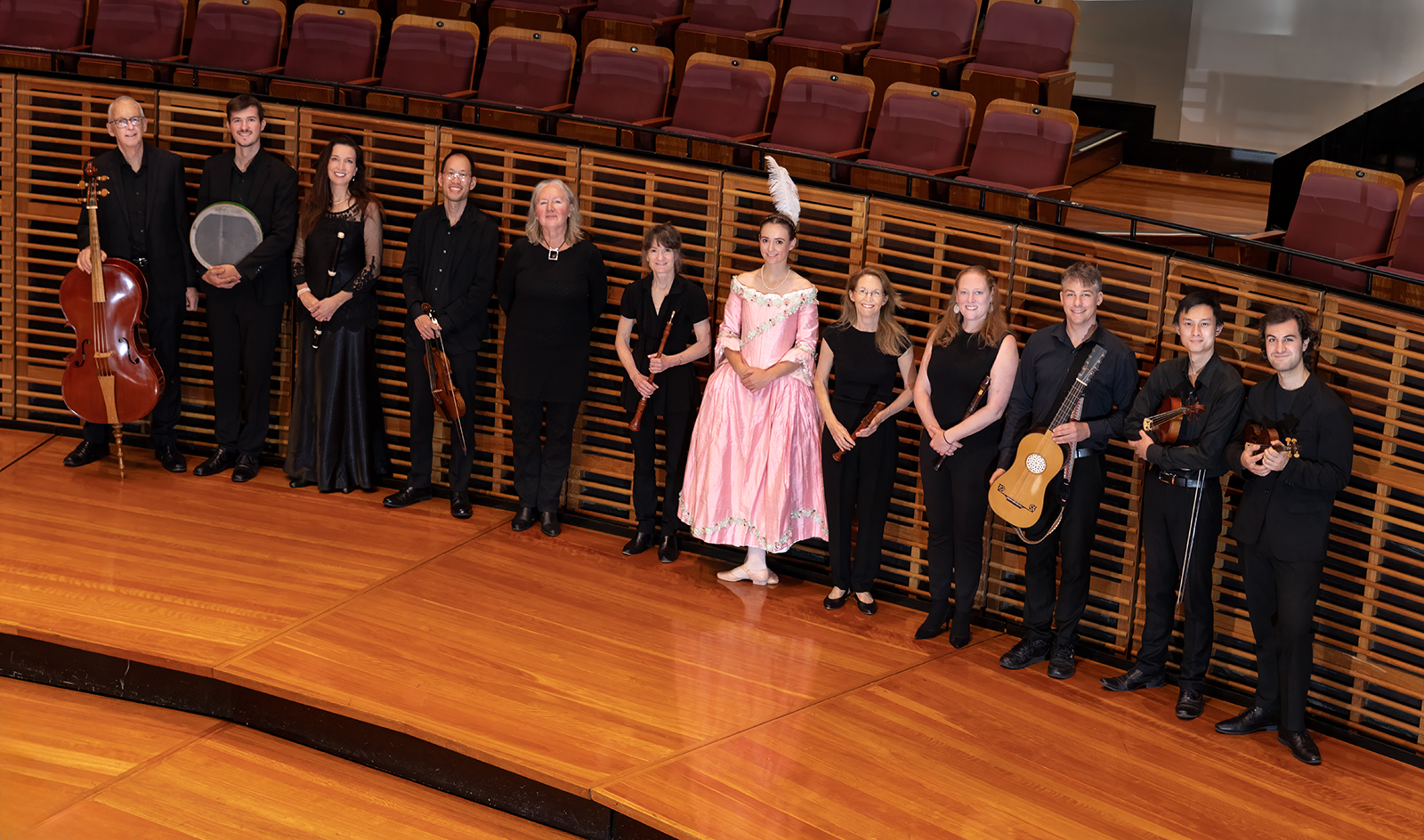
Baroque dance.
It was high time for a Baroque concert centred on dance. It is well known that Bach took dance lessons. At least since Froberger, so many of the old Renaissance dances, including both the courtly and the provincial, became the models for keyboard partitas. So too what came to be known as the ‘orchestral suites’.
The influence of dance did not stop there. It bridged the gap between sacred and profane. Bach’s cantatas are imbued with dance. Even the openings of his Passions recall the tombeau.
Unsurprisingly, the focus of this program was on the profane. It opened, fittingly, with Rebel’s Les caracteres de la danse, composed in 1715 by a man with a flair for the dramatic. One has only to think of Rebel’s later, shocking, Les Elemens. His Les caracteres de la danse was less novel, but no less dramatic. The sprawling, galante, prelude was followed by the first dance – a courante – by which time the ensemble was joined by a dancer. The lively Bouree was punctuated by bursts of percussions, and the chaconne (which we know was played faster than the passacaglia) was much lighter. The Sarabande had all the hallmarks of a French plainte, marked as it was by delightful accompaniment on flute, by Sally Walker. There was much deft footwork in the Gigue and, of course, in the Passepied (meaning, as it does, passing the feet). It was all rounded off by a rollicking sonate, sans danser, in which the strings showed off their mastery of dynamic variety.
Graupner’s Le Desire brought with it a change of scene. It was an experimental instrumental piece which had a hint of the operatic. A sprawling and somewhat nostalgic solo violin part, recalling an operatic aria, is accompanied by strings pizzicato. The experiment was stretched further in the Uccellino from Graupner’s Ouverture in G major. Uccellino, of course, means little bird. Walker begins flutter tonguing on the flute which gives the effect of a sparrow song, followed by light trill and a humorously episodic series of rambling passages, false starts and sudden endings. These pieces showcased more of the programmatic than of the world of dance.
Dane returned with Erlebach’s trio Sonata No 2 in E minor, and with Telemann’s Overture-Suite in B-flat major. The dancer also returned with Purcell’s Instrumental Dances from The Fairy Queen. In these, Purcell drew heavily on the French style, which could be seen in the rondeau. But the hornpipe was distinctly English. Handel seemed to have been particularly fond of it.
James Oswald is a name not familiar to connoisseurs of the Baroque – a Scottish composer appointed as Chamber Composer for King George III. His The Marvel of Peru has a distinctly Scottish brogue, based as it is on a Scottish pentatonic scale.
An exploration of Baroque dance would not be complete without Lully. The man quite literally gave his life to it – he stamped his conducting pole so vigorously on his foot while conducting a dance that he died shortly thereafter, of gangrene. The dancer joined us for the Pavane des Saisons from Ballet des Saisons. The idea of a ‘ballet of the seasons’ must have inspired Purcell to do the same, in his Fairy Queen. In any event, the pavane is one of the oldest dances, hailing as it does from the old city of Padua.
Next was Johan Helmich Roman. Roman was evidently well-placed to give us an insight into the world of courtly dances. He led the Swedish Royal Orchestra and composed the famous Drottningholmsmusique, which was performed in the splendid palace of the same name. Each movement was decidedly French.
Removed from all this was Fa nye mama, a Romani folk dance song. In classic gypsy style, it began with a slow exposition of the recurring bass and finished with fast, upbeat improvisations, with fiery passages from John Ma on violin. The ending showed that dance in the Baroque was not the preserve of the courts of Western Europe.
Note: cover image photo credit Paul Porteous.