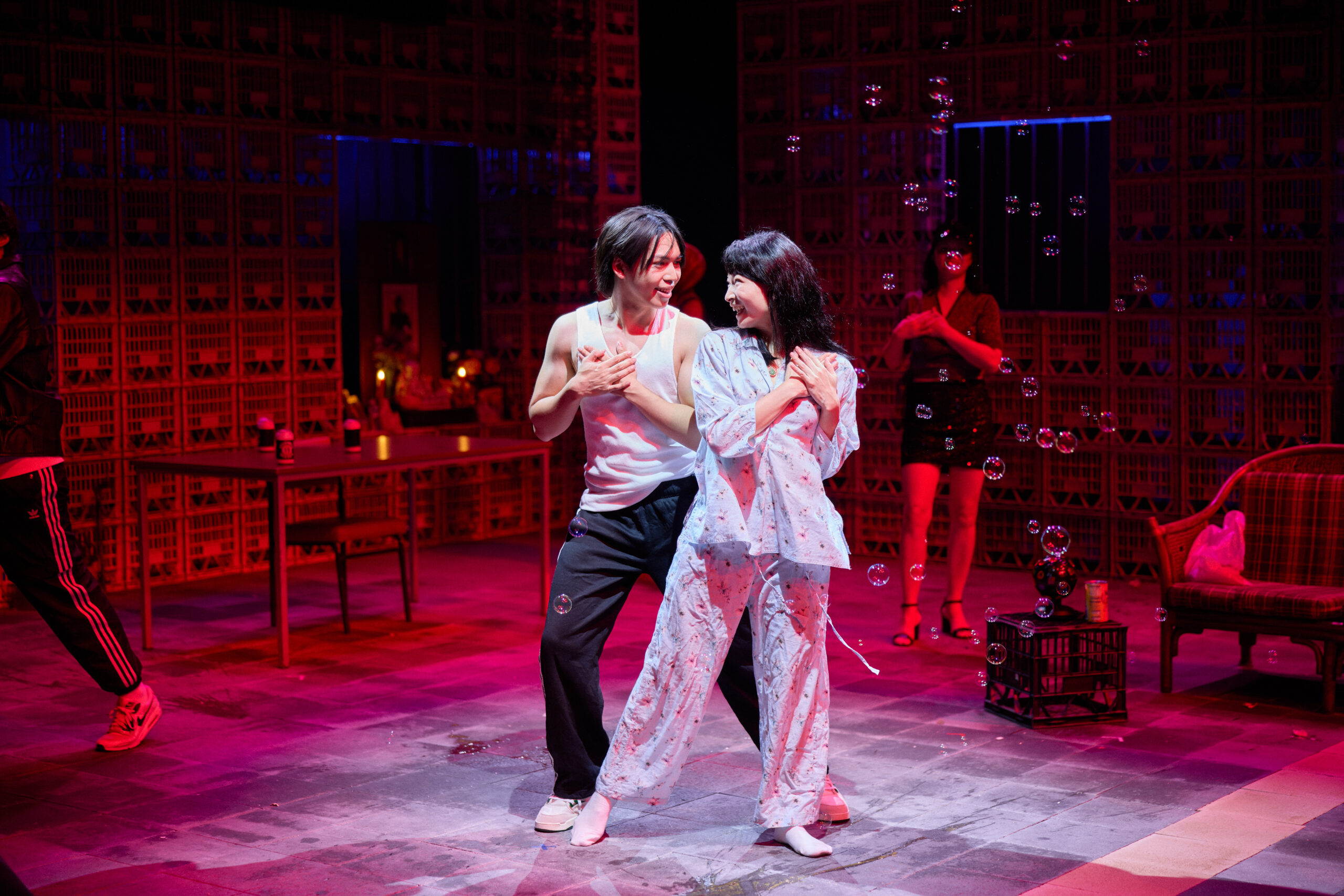
Vivian Pham’s bestseller The Coconut Children comes to life in its much-anticipated stage debut at Belvoir St Theatre.
Directed by Hannah Goodwin and Catherine Văn-Davies, this revolutionary coming-of-age story delves into the lives of two emotionally complex teenagers whose shared past brings them together once more, as they navigate their vulnerabilities, the messy realities of growing up, and what it means to prioritise their own needs. And it is wonderful.

Set in 1998 in Cabramatta, the story follows 16 year olds Sonny Vuong (Gemma Chua-Tran) and Vince Tran (Kevin Khan) as they navigate adolescence. Kooky, erratic and endlessly creative, Sonny is a daydreamer who feels lonely despite being surrounded by her family and friends. Between her overbearing yet hardworking mother Hu’o’ng (HaiHa Le), carefree Ba Ngoai (Van Doan), goofy brother Oscar (Christy Tran), and overzealous best friend Najma (Rabia Majeed), Sonny struggles to balance the expectations placed on her as the eldest daughter.
Meanwhile, Vince has just been released from juvenile detention and faces an uncertain future, caught between friends, returning to school, a dodgy job, and his sense of self. After he catches Sonny reading questionable material at the local golf club, they are forced to confront the intricacies of love, culture, hardship, dependency and communication, whilst learning to understand themselves and their own needs.

Chua-Tran delivers an exceptional performance and captures the full spectrum of Sonny’s emotions, from her anxieties and anguish to her more erratic and humorous moments. Her deadpan delivery of witty lines was extremely hilarious and a highlight of the production. Christy Chan was equally compelling, shifting between multiple characters with ease and versatility. Kevin Khan and HaiHa Le brought a rather emotional weight to the production and left a lasting impression on the audience.
The most impressive part of the show is the cast’s ability to double as the backstage crew, speedily rearranging furniture and props between scenes. The staging (Luke McGettigan) is equally creative, with multiple scenes unfolding simultaneously across the stage. When one group of actors engaged in dialogue, another continued with seemingly mundane activities in the background, before the focus shifted between them. This clever use of space and overlapping scenes creates a rather engaging theatrical experience.

The set and costume design (Dale Ferguson) choices are rather unique. Plastic crates are stacked to create makeshift walls and rooms, allowing multiple settings to coexist on stage. The costume choices also reflect generational and cultural differences, with Hu’o’ng and Ba Ngoai wearing traditional clothing to represent the culture they continue to hold on to, whilst the younger characters wore school uniforms and streetwear. The lighting (Phoebe Pilcher) further complements the production, using spotlights to heighten the intensity of the more emotional scenes.

Yet, the greatest joy of The Coconut Children is the world its writer creates. Vivian Pham presents a vision of 1990s Cabramatta that is beautiful in its authenticity, from the nuanced characters that reside in it to the soul within the seemingly innocuous homes and schools. Such people and places are layered and complex, as the former undergo the awkwardness of growing up within the confines and pressures of the latter.
But what emerges is a vibrant relationship between Sonny, Vince, Hu’o’ng and their surroundings, where each inform the another in a beautiful display of belonging, identity, and place. Pham’s play, like the novel preceding it, creates a world you enter and don’t want to leave.
The Coconut Children blends emotion, culture and history into a deeply resonant exploration of identity and belonging, capturing the beauty and discomfort of growing up. It should not be missed.