The sacred and the profane.
The North German Baroque had the Abendmusiken. The sublime, mystical, devotional evening music in the northern Hanseatic states which counted the likes of Buxtehude and Bruhns in its numbers.
The Italian states had Stradella and Caldara. These were composers equally at home in the secular and the religious. Their religious music was rich, deeply spiritual, mystical, almost quietist.
Hence the title of this concert, Sacro e Profano. It is a theme that runs throughout the Baroque, less so the Renaissance. The bridge between the sacred and the profane was dance. It is well known how Bach elevated much of his secular tunes – grand cantatas for town council elections, orchestral suites for secular courts, and – to divine dedication. Handel did the same. After all, why must the devil have the best tunes?
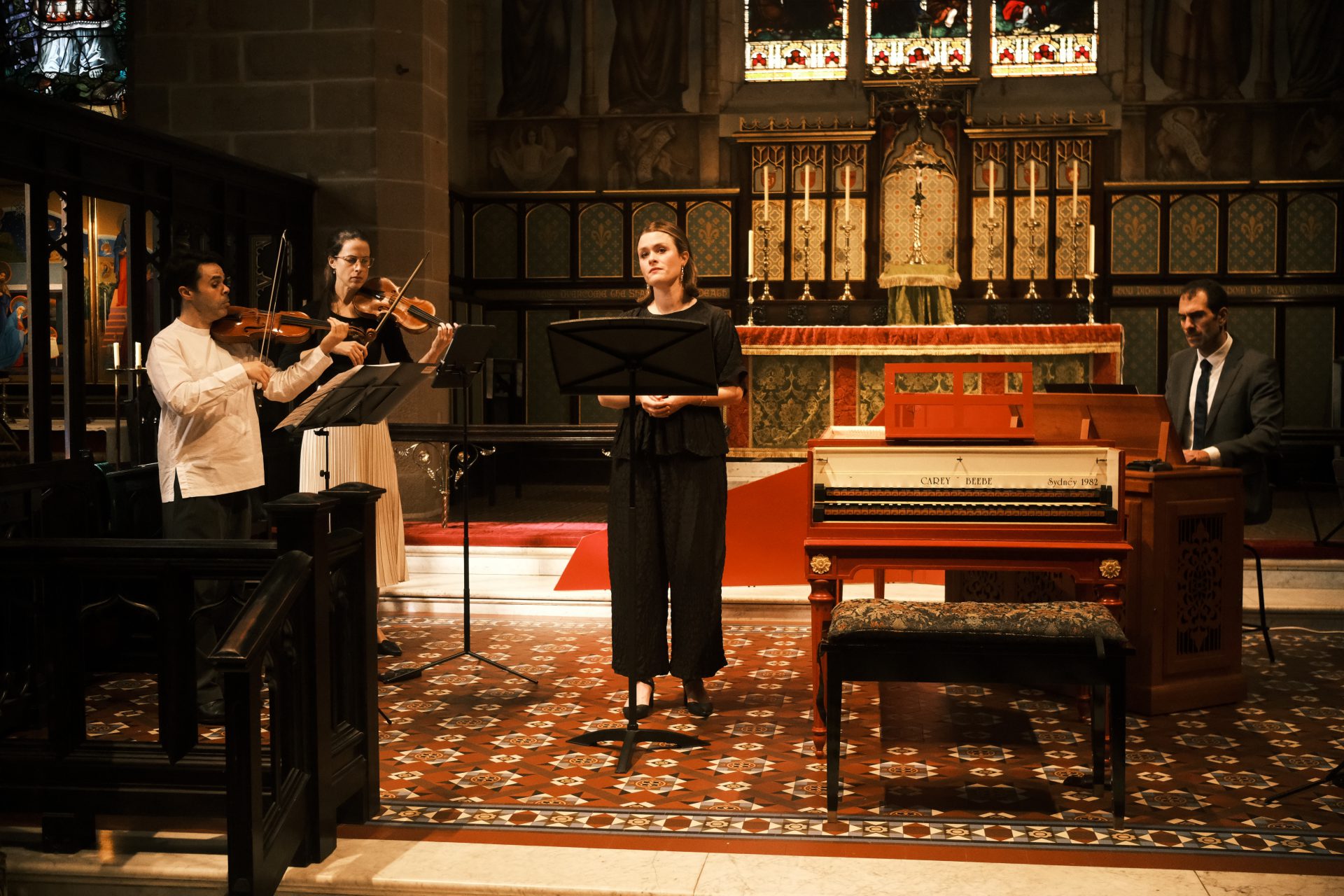
Given that the program was centred on the Italian baroque, it was only fitting that it started off with a Corelli trio sonata. After all, Corelli himself was famed as much for his sonata di chiesa as his sonata di camera.Here was Corelli’s Trio Sonata in D major, Op 4 No 10. The core of The Muffat Collective – Matthew Greco, Rafael Font Viera, Anton Baba and Anthony Abouhamad – was joined by violinist Ella Bennetts. Some of the sharpness and precision of the melodic lines in the first movement was lost in the acoustic morass of the vast Christ Church St Laurence. But the acoustics worked better with the slower movements.
Fresh from her performance as Voce di Dio in Pinchgut’s performance of Scarlatti’s Il Primo Omicidio, mezzo-soprano Stephanie Dillon joined for Stradella’s Croifissione e morte di Nostro Signore Gesu Christo. It is an exemplar of the sort of spiritual, evocative, almost programmatic, cantatas that were sung as devotional music. The scene is the crucifixion of Christ. It begins with a lush instrumental opening, sans cello, which is very much a dialogue between violinists Greco and Bennetts. It was typical of a lament. Greco embellished the melodic lines with typical Baroque rhetorical finesses. Abouhamad complemented on continuo organ, including a tasteful opening. Dillon’s warm, burnished, voice was well-suited for this piece.
Next was a trio sonata by Antonio Caldara in B flat major, Op 2 No 2. It has the same structure as the Stradella trio sonata, performed earlier, but is full of witty and inventive passages.
The taste of the profane continued with Caldara’s Medea in Corinto. It has a distinctively sunny instrumental opening, which was performed at a sprightly pace to great effect by Greco and Bennetts. Dillon played the part of a cheated Medea, whose gradual descent into madness is lightened only by a clear-eyed call for vengeance. Her characteristic projection – which is almost declamatory in effect, and which therefore worked wonders in the Scarlatti last month – was on full display, especially in the more dramatic passages.
Caldara’s Chaconne in B-flat major Op 2 No 12 is based on a simple ground. But subtle aural tricks allowed the piece to traverse several keys in the space of only a couple of minutes. It was a fitting way to end, and was an exemplar of the richness of Italian baroque instrumental music.