Baroque humour.
Bach is known today as the stolid old master of counterpoint. Beneath all the austerity was a man of subtle wit and hearty humour. His secular cantatas tell us as much.
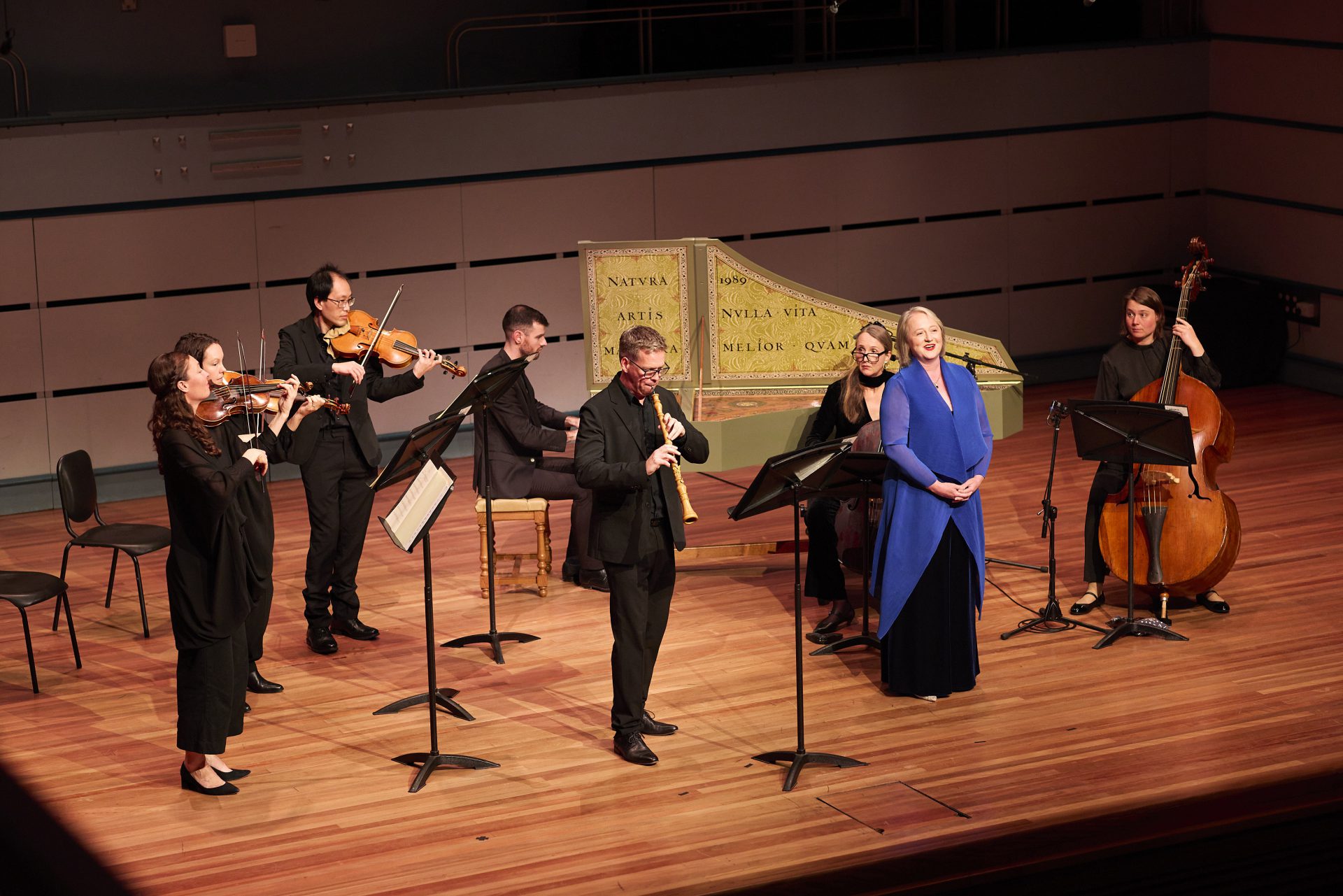
In this well-curated concert, Bach’s wedding cantata Weichet nur, betrubte Schatten is paired with the famous coffee cantata, Schweigt stille, plaudert nicht. Miriam Allan is joined by her father, baritone Christopher Allan.
The first set of pieces, before the interval, appears to have been centered on the theme of light and darkness. That theme permeates much of the Wedding Cantata, speaking as the text does of light and ‘dismal shadows’, ‘frost and wind’ and pleasant ‘spring breezes’, ‘thunderclaps’ and sweet ‘contentment’.
Simone Slattery valiantly stepped in at the last minute for the indefatigable Madeleine Easton, who had broken her arm. That is no mean feat. The principal violin does much of the heavy lifting in this cantata. The opening arpeggios are redolent of a procession (think back to Zadok the Priest). The obbligato part of the elegiac Wenn die Fruhlingslufte streichen sets the scene for the wafting ‘spring breezes’, although it seems the recurring turning motif was at times rushed. In this aria, Allan was at her best.
Of course, that is not to overlook the oboe and the cello. Adam Masters performed with characteristic clarity, and Anthea Cottee despatched fiendishly difficult cello passages in Pheobus eilt mit schnellen Pferden with apparent ease.
Each member of the ensemble shone in the cheery Sich uben im Lieben. Especially the basses. That is just as well. This aria has a rustic, almost percussive, quality to it, especially in the transition between repeats. This was well realised by Pippa Macmillan on double bass.
WF Bach’s Sinfonia in D minor F6 stuck with the theme of light and dark. As with most of WF Bach’s rococo pieces, this sinfonia is almost unsettlingly saturnine. It begins broodingly with a series of pulsating strings, with a jarring dialogue between oboe and Mikaela Oberg on flute. As usual, Oberg gave us a masterclass in the expressive potential of the Baroque flute, especially dynamics. Then the fugue comes like a flash of lightning. So busy and energetic is this fugue that at times it seems the ensemble lost control and timing, but it all picked up resoundingly with the jumping passages on flute which were imitated on strings.
The Ich wunschte mir den Tod is one of the most heart-rending arias Bach ever composed. The ensemble played at a deliberately slow pace, which gave the effect of the sombre dragging of feet. Allan’s voice was light and controlled at first, but with especial dramatic effect on some iterations of Tot, especially when descending into the lower, more guttural, register of her voice. Even inadvertent departures from the score were made to seem effortless.
No Bach piece better captures a wintry Sydney night than the overture to Bach’s Orchestral Suite No 2 in B minor. This featured the ensemble at its finest.
But of course the main fare was Bach’s Coffee Cantata. Dan Walker declaims the introduction to the entire conceit with a clear and honey-timbred tenor voice and impressive articulation.
In this case, the father-dynamic was not just a metaphorical conceit. Singing alongside her daughter, Christopher Allan begins with a billowing blokey Germanic baritone voice.
Again, Oberg’s expressive powers were on full display in the Ei! Wie schmeckt der Coffee susse. So too Miriam Allan. Her voice tended to waft effortlessly above the audience. The full force of Christopher Allan’s voice was unleashed in the ranting Madchen aria, which was redolent of many of Bach’s more sinister arias in his secular cantatas. It all comes together in the pastoral aria Heute noch and chorus Die Katze lasst.