Christmas in November.
In Sydney, it is a balmy November. In Bach’s Leipzig, November would have marked the beginning of the tempus clausum – a period of quiet reflection, usually beginning on the first Sunday of Advent.
Bach’s employer in Weimar did not impose a tempus clausum. But the period must have been a welcome reprieve for a busy cantor. We have that period to thank for many of the Advent cantatas presented in this performance.
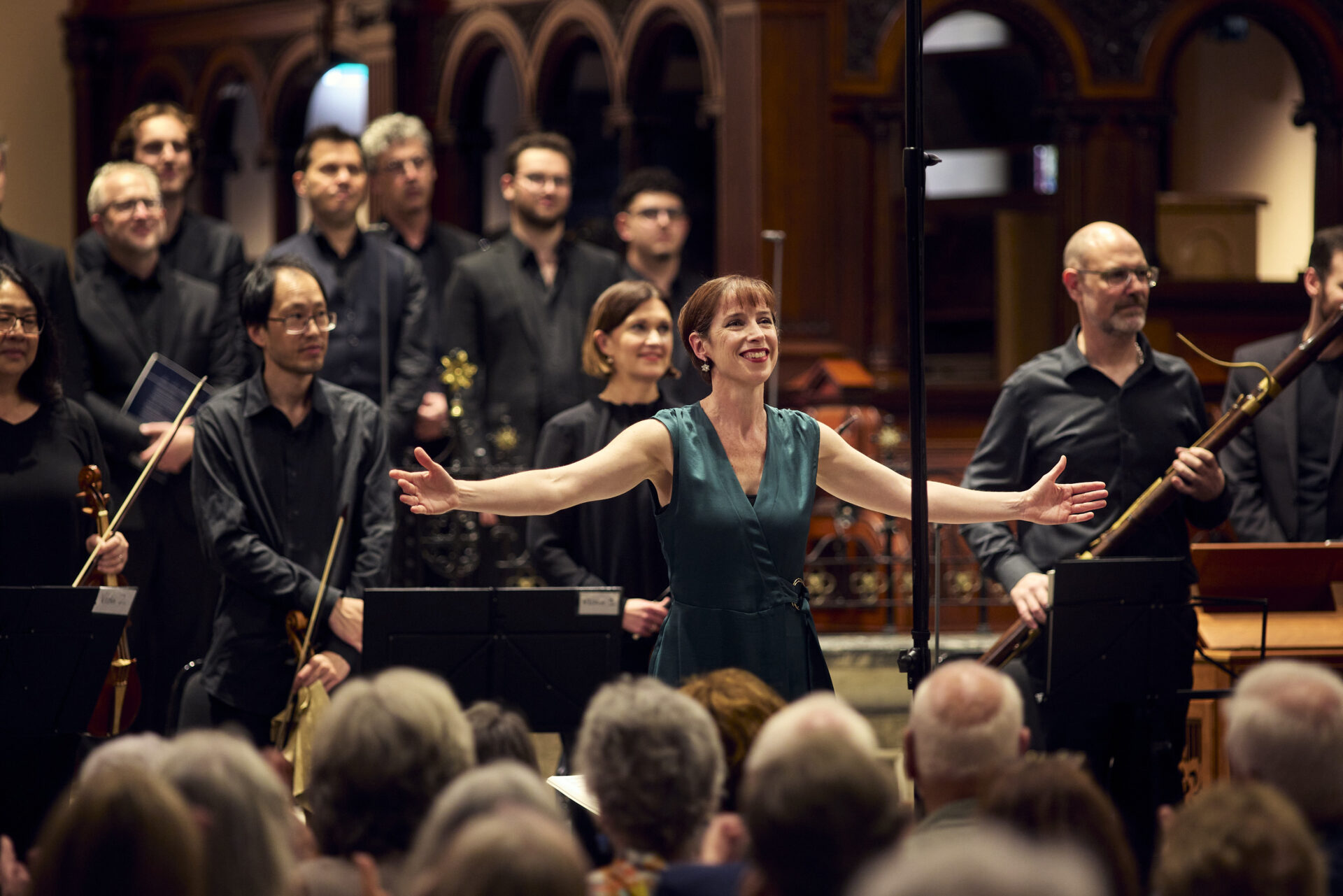
But first was Charpentier. Charpentier gives us the best of both dominant musical styles of his time – French rhythm and Italian dramatism. Madeleine Easton tastefully sandwiched the Messe de minuit pour Noel between two sets of Charpentier’s Noels pours les instruments. Much like Corette’s Les Six Symphonies de Noel, these were based on popular French carols. Each had the flavour of a pastoral sinfonia.
The third carol – Or nous dites Marie – stood out. Unlike the other sprightly tunes, this was performed grave. Concertmaster Julia Fredersdorff – of Van Diemens Band fame – performed with luscious vibrato, all of which centred on chromatic lines performed by Daniel Yeadon on cello. This captured the more contemplative side of Christmas.
The famous opening Kyrie of the Messe de minuit was performed at a sprightly pace. It was evidently based on the carol, Joseph est bien marie. The following Christe eleison was severe and heavily contrapuntal, and built beautifully on the tension between the tenor and bass voices. It was deliberately redolent of the Or nous dites Marie. In particular, Kyle Stegall excelled, as he did in the et exspecto that was to follow.
Soprano Veronica Vella shone in the Tu solis, and the pace picked up resolutely in the closing Amen.
The distinctly Italianate mastery of prepared dissonances was on full display almost immediately in the Credo; certainly from factorem caeli, and on “mortuorum”. These were hallmarks of Carissimi’s tuition.
All of this was performed with the confidence and maturity of an ensemble nearing its tenth anniversary year.
Following a short interval came two of Bach’s advent cantatas. The first was the dramatic Nun komm der Heiden Heiland, BWV 62. It is not as dramatic as the tempestuous Nun komm der Heiden Heiland, BWV 61. But much of the dramatic potential comes from the dissonant augmented fourth that is latent in the underlying hymn, based as it is on Veni redemptor gentium. That hymn formed the basis for the equally dramatic C-sharp minor fugue in Bach’s first Well-Tempered Clavier.
The opening was performed at a fast pace, and it seems the oboes had difficulty catching up. The sopranos declaimed the cantus firmus.
The first aria was for tenor. It was performed by Aaron Erdstein with the forceful clarity of a trumpet. That is no mean feat. This aria is riddled with meandering lines.
David Greco performed the following recitative and aria, with all the march-like vigour one would expect of a Lutheran Christmas cantata. The words say it all: “Streite, siege, starker Held!” The aria’s style is strangely reminiscent of the equally thunderous “Gewaltige stößt Gott vom Stuhl” in Bach’s earlier “German Magnificat” (BWV 10) – a sinewy bassline and a full-bodied bass voice combining to evoke an epic struggle between good and evil, strength and weakness, virtue and temptation.
In the next cantata, BWV 70, Easton mastered dynamic variety by making the opening chorus gradually build up like a momentous wave crashing upon the audience. Yeadon’s cello introduction for the alto aria was faultless and expressive as ever.
All of this is a long way of saying that, with the benefit of Bach Akademie, Christmas can never come too soon in Sydney. One can only imagine what wonders the Bach Akademie has in store for their audiences next year, in their tenth anniversary.