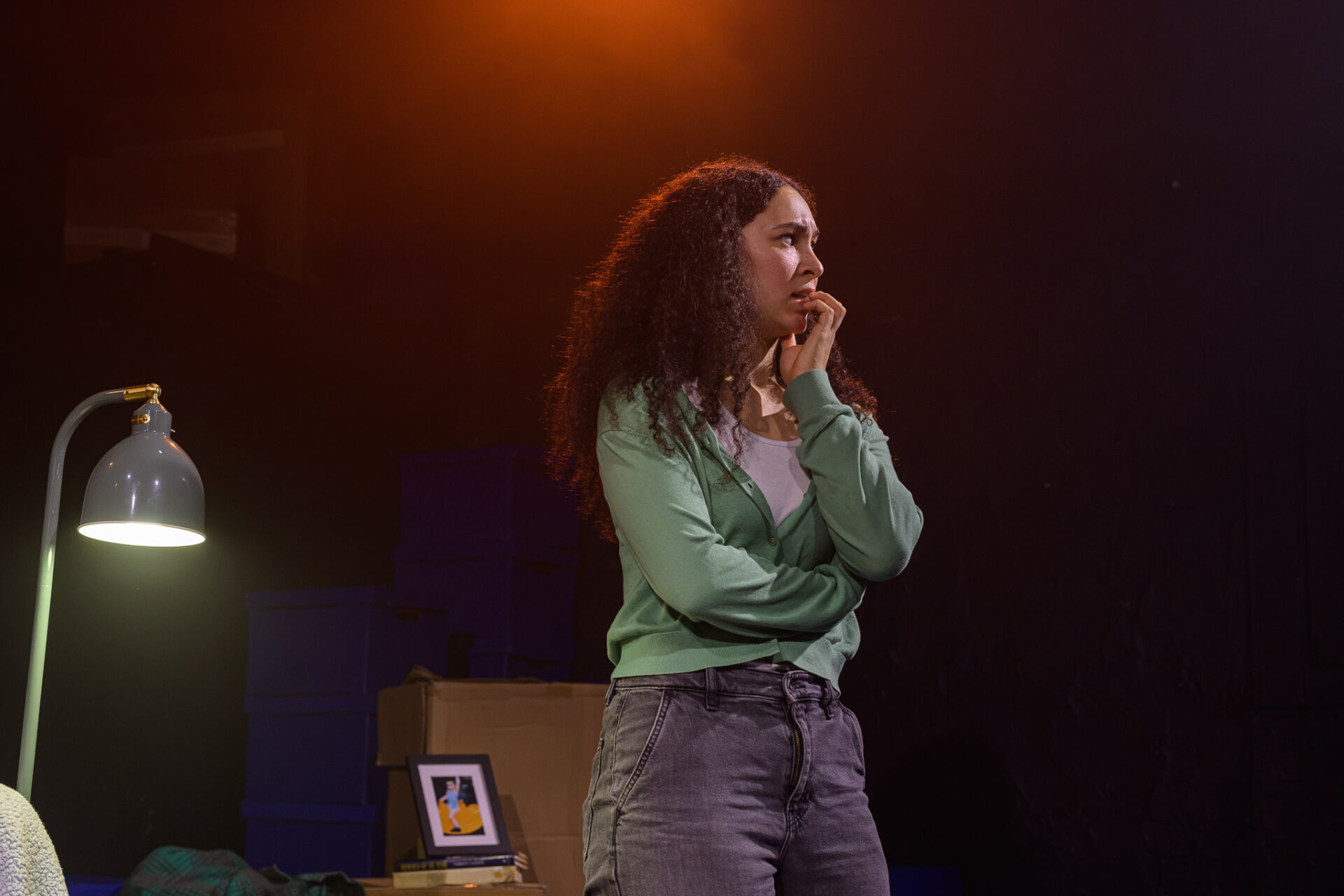
Lil Tacker Productions presents A Number by Caryl Churchill at the Old Fitz Theatre. Directed by Julia Pierrette, this passionate production stars powerhouse father-daughter duo Danny Adcock and Jolie James who navigate the play’s complex family dynamics and probe into the foundations and fragility of identity, individuality and relationships.

Salter (Adcock) and his daughter Michelle (James) share a close and affectionate bond. But when rumours of human cloning begin to surface, the foundations of their relationship begin to unravel. Michelle, driven by curiosity and fear, and Salter, volatile and resistant, challenge each other, questioning the authenticity of their existence and relationship. As the truth slowly comes to light, a troubling question emerges – is Michelle the original daughter, or merely one of many duplicates? As doubt begins to consume her, Salter’s once steadfast fatherly presence begins to erode, giving way to a distant and unrecognisable past version of himself.
It’s not often an actor snaps you into your seat, but Adcock is one of them. His portrayal of Salter is emotionally raw, the tremors in his voice conveying years of unresolved guilt and grief, whereas his explosive outbursts are infused with uncomfortable contempt. He delivers cunning rationale with such conviction it makes it difficult to dismiss despite such obvious flaws. Comparatively, James injects the stage with a comedically nervous demeanour. Her versatility is particularly commendable as she takes on multiple roles with ease, seamlessly shifting to a different personality.

The script (Churchill), however, leaves several important questions unanswered. Salter’s actions during Michelle’s early childhood and the motivations behind them remain somewhat unclear throughout. His dishonesty and ambiguity only exacerbate this, obscuring his true intentions. Michelle’s motivations are similarly underexplored. After years of absence and abandonment as a result of Salters neglect, the real Michelle’s emergence at a time when cloning has become reality is not fully explained. Was she intending to exploit such developments, or were her actions always intended? While such questions provide plenty for the audience to ponder upon, it feels a bit excessive and unclear.

The stage design (Grant Brennan) creates a warm and intimate environment, yet its untidy state invites deeper interpretation. The unopened boxes and messy couch leave the audience wondering whether such disorder reflects that of Salter and Michelle’s psyche, and whether the pair have recently relocated or are merely neglectful.
The sound (Emma Snellgrove) and lighting (Paris Bell) complement the production well. The stage shifts into neon hues between scenes as haunting yet subdued sounds emanate the space, allowing the audience time to not only reflect on the emotional weight of each scene, but also to contemplate truth and deception between the characters. The repeated pauses did however feel extensive at times, diminishing its effectiveness as the play progresses.
Although there are moments of persisting ambiguities, the production’s emotional influence remains. A Number ultimately provides a compelling piece on the unknown and its impact upon relationships.