
A slow start, but a strong finish.
Bennelong in London, written by Jane Harrison and produced by Sydney Theatre Company, is a measured exploration of First Nations identity and the life of Woollarawarre Bennelong. With crisp performances and a script that blends humour and cultural insight, it is a sure crowd pleaser. But despite its powerful conclusion, the production struggles with momentum.

Bennelong in London tells the story of Woollarawarre Bennelong (Googoorewon Knox), the Wangal man who became the key dialogist with British colonists following the arrival of the First Fleet. Moving between historical events, the play explores Bennelong’s relationship with Governor Arthur Phillip, his forced removal from Australia and journey to England, and the lasting impact of colonisation on First Nations people. Running parallel is the story of a modern First Nations actor (Guy Simon) preparing to portray Bennelong, whose growing understanding of his own identity reflects the historical figure’s enduring legacy.

Simon delivers a spirited performance, capturing the script’s humour and his character’s uncertainty of a man negotiating Indigenous identity. His character’s growing understanding that culture lives through him is one of the show’s most resonant ideas. Simon conveys this evolution warmly, with his understanding of Bennelong and what it means to be a First Nations person in 2026 striking.
Knox is equally engaging as Bennelong. He portrays Bennelong not as a passive historical figure but as a man navigating extraordinary circumstances. Knox avoids reducing Bennelong to saint or sinner, instead presenting someone constantly weighing survival, diplomacy and loyalty. The result is a performance rich in humanity.
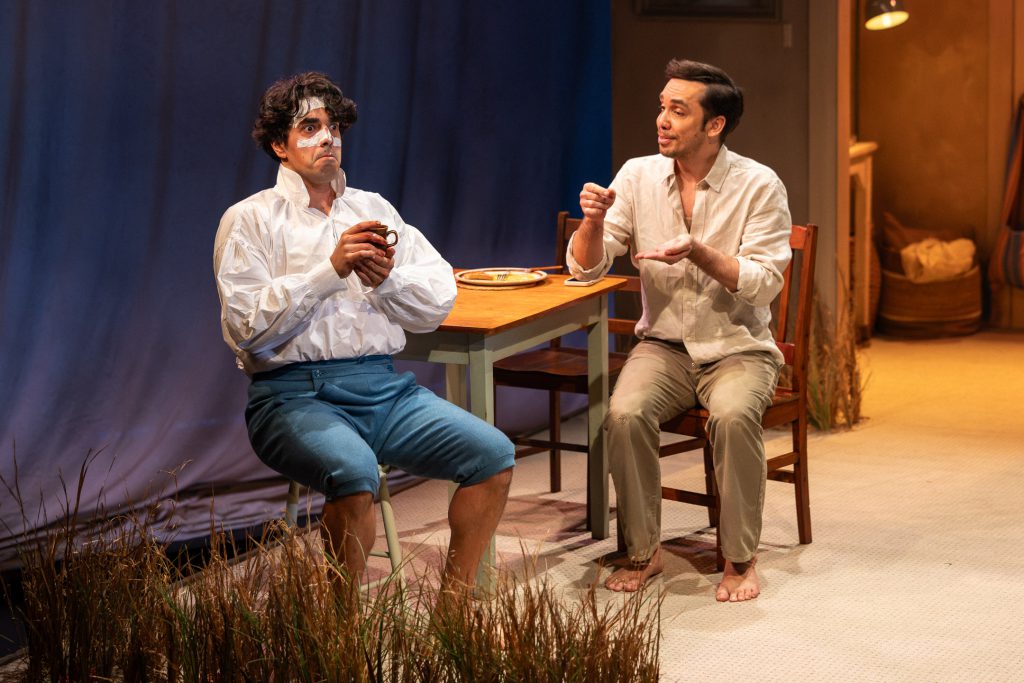
Harrison’s script deftly balances humour with cultural insight. Her writing illustrates the resilience of First Nations culture and its capacity for continuity in the modern day, particularly through the parallel between past and present. The play’s reflections on belonging, representation and historical memory feel both specifically Australian and universally relevant.
Yet for all its thematic richness, Ian Michael‘s direction suffers from an uneven sense of pace. For over half of the show’s 90-minute run time, the staging adopts a slow pace that works against the material’s emotional power. Over that period, the audience reaches emotional and intellectual conclusions well ahead of the on stage action. Moments designed to land with revelation instead feel prolonged as a result.
Fortunately, the production finds its footing in its closing moments. As the historical and contemporary narratives converge, Harrison’s central argument about the continuity of First Nations culture crystallises with force. The ending leaves a hopeful reminder that culture survives through those who continue to carry it forward.
Ultimately, Bennelong in London succeeds in reaffirming the enduring strength of First Nations culture. Harrison’s writing offers an insightful reclamation of a complex historical figure, and its exploration of First Nations identity and resilience is thoughtful.