Domenico Scarlatti was famously prodigious. He composed 555 sonatas for keyboard, most of them fiendishly difficult and all of them betraying the influence of the Iberian on the soundscape of 18th century Naples.
Domenico’s father, Alessandro Scarlatti, was no different. He composed some 65 operas and drammi per musica, mostly liturgical. The Naples of his day was robustly traditional. It was one of the last outposts of the stile antico. But even by his time, the city was starting to come into its own with the advent of Neapolitan opera.
The story of Cain and Abel is ripe for musical reimagining. This opera was meant to impress the Venetian cognoscenti – no mean feat at the time. The libretto was written by Cardinal Pietro Ottoboni – cardinal at age 22, Venetian artistic patron in his 30s, and supporter of Corelli.
Corelli is worth mentioning. Much of the music in Scarlatti’s Il primo omicidio is distinctly Italian. There is none of the sharpness or hyperbole of French opera. The pace privileges proportion over the bombastic, even if the effect is sometimes slow and meandering. The result, it must be said, is that some of the music is quite unremarkable. After all, we largely have Neapolitan opera to thank for the drama-sapping arias da capo which took Europe by storm.
Squeezed into the small space between the stage and the first row in Sydney’s Rosyln Packer Theatre, the Orchestra of the Antipodes took its cue from principal violinist, Matthew Greco, with a shining solo opening. Again, none of the bombasticism of a French opening. This is Italian sinfonia at its best, wavering effortlessly between light and dark in equal measure.
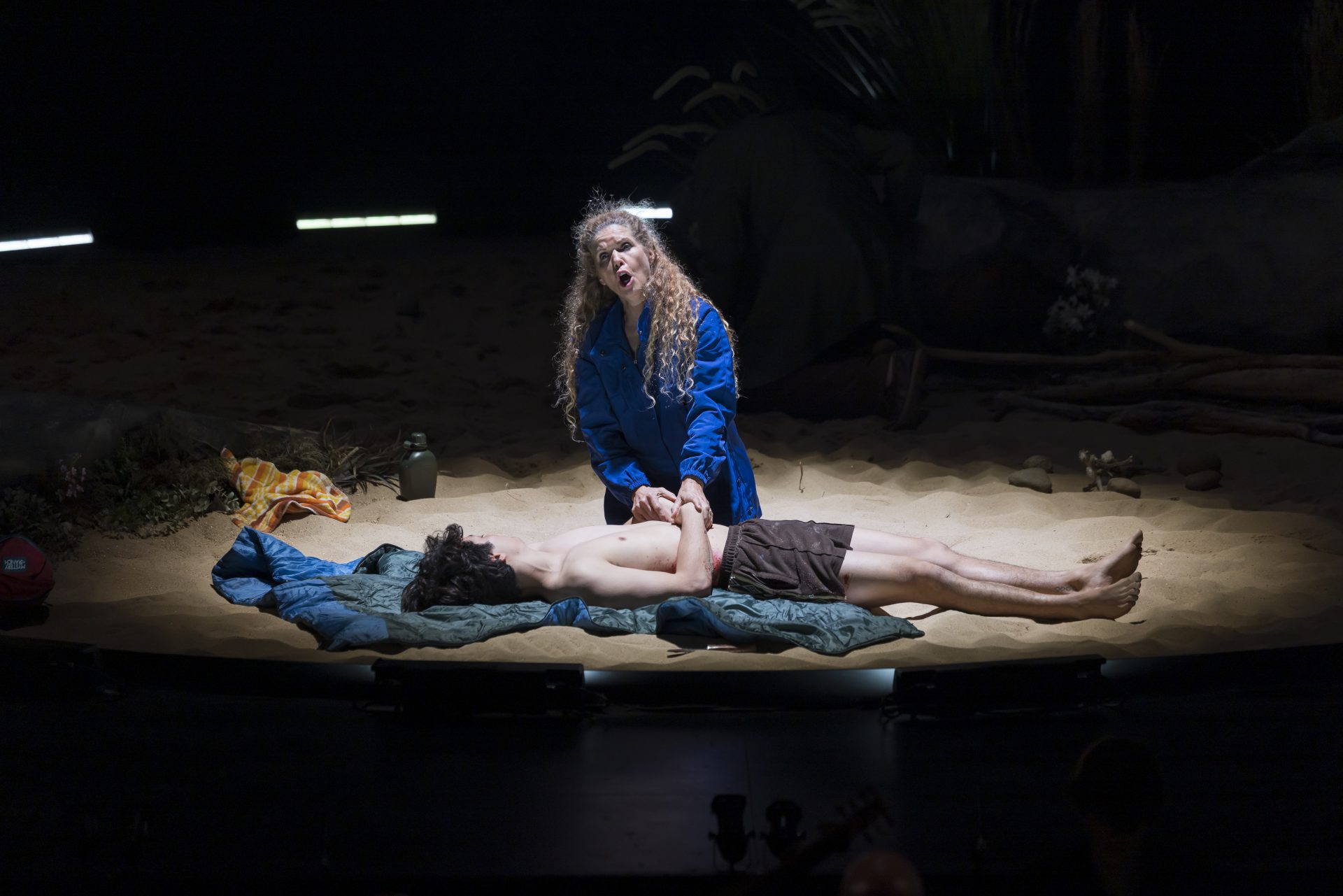
Kyle Stegall and Sara Macliver emerge on stage as Adam and Eve. They lament their station and recall what condemned them to earth. From the outset, Macliver’s voice was light but firm. Stegall’s voice matured, most fully in the middle of the second Act.
Two young actors play brothers Abel (Ty Arnott) and Cain (Ewan Herdman). They are doubled by soprano Madison Nonoa and mezzo-soprano Ashlyn Tymms. Nonoa’s voice was light and elegant and displayed remarkable control, especially in the higher registers and especially when singing sotto voce.
One of the best moments was when Lucifer descended to tempt Cain into murdering his brother. The music thickened. The strings despatched rollicking, almost guttural, scales and Erin Helyard moved from the nasal Italian continuo harpsichord to the snarly regal organ, which has the timbre of a Renaissance racket or bassoon. Not by accident was it the instrument of choice to depict the underworld.
As Lucifer we had Freddy Shaw, who distinguished himself in Pinchgut’s last choral performance, in Messiah last year. He has a commanding bass voice which is beyond his years.
Another highlight was Abel’s Andiam mio caro aria. The young actors walk in slow motion as Nonoa and Tymms sing a tender extended dialogue. This is early Italian opera at its finest, mastering as it did the unity between text, rhetoric and music.
Voce di Dio dominated much of the second Act. It was sung by Stephanie Dillon with robust presence. It was at this point that the characters of Adam and Eve are imbued with the most pathos. Stegall’s voice becomes more honey-timbred and controlled. The entire variety of the human condition is captured in the slightest of casts and the smallest of stages.
The entire conceit was rounded off with the devastatingly simple, and dark, flavour of a Purcell viol fantasia, with its distinct English cadences and jarring chromaticisms, again wavering between light and dark, but leaning more toward the tragic.