The last decade has seen renewed interest in the lives and contributions of the Scott sisters, Harriet and Helena.
Now, for the State Library’s bicentenary, an immersive multimedia work by Creative Director Skye McIntosh combines a string quartet, the sisters’ drawings brought to life through animation, and a script with four actors.
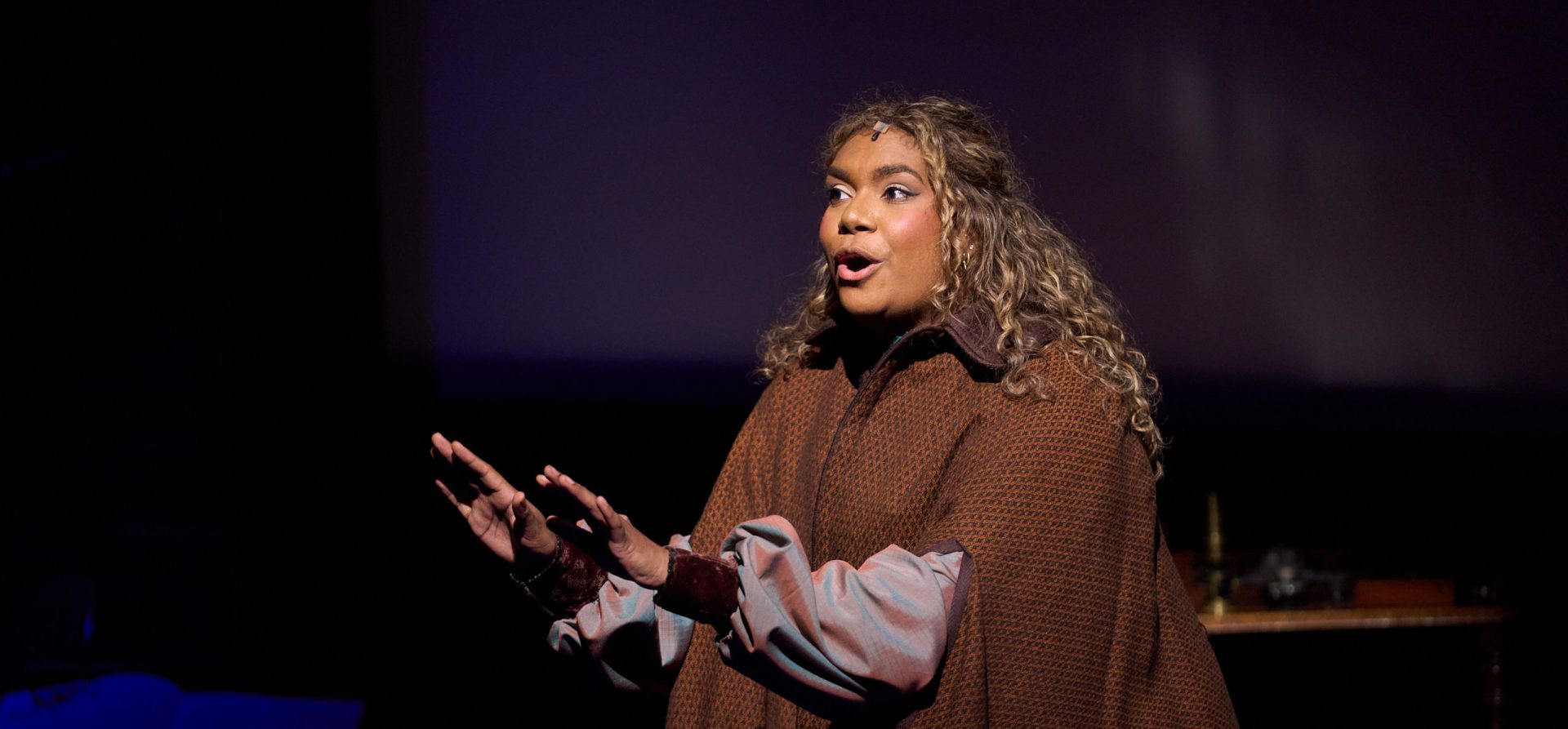
The production follows the background and life of Harriet and Helena from before they were born to Helena’s death. Around them are their imperial grandmother Augusta Frederick Scott (Madeline Flood), their father, Alexander Walker Scott (Ren Watson), and their mother, Harriet Calcott (Tierney Clark). Acting as the narrator and keeper of memory is Lucy (Najwa Adams-Ebel), an Awabakal woman who lives on Ash Island, coexisting on land with the Scott family.
The production shows how the Colony reordered the English social world, curbing class and gender divides while emphasising culture and race as markers of belonging. Alexander, a Cambridge graduate, fathered two daughters out of wedlock with a seamstress whose parents were convicts. In England, this illegitimacy would have stained them for life, but in the Colony it was unremarkable. Educated by their father, they became two of colonial Australia’s finest natural history illustrators. While the Awabakal people were marked as outsiders and dislocated, the work suggests that some remained on Ash Island.
The physical world was reordered too, as the English catalogued and cleared an unfamiliar land, driven by the faith in progress that Augusta carries from England. Progress came at a cost; for a butterfly to be accurately illustrated, it was killed with chloroform upon emerging from its chrysalis. That sacrifice ensured the species could be recorded. Language, too, was recorded; Biraban shared the gift of Awabakal language with missionary Lancelot Threlkeld, and when colonisation silenced it, the record awaited Awabakal voices to give it life again.
Lucy gives the language that life on stage. Similarly, she tells us that Ash Island’s native plants and animals, diminished by land clearing, have been restored through Western knowledge from books, like those in the State Library, and Awabakal knowledge, transmitted orally like the work itself.
The writing and stage direction by Rachel McDonald is masterful, weaving a joyful story with real nuance. It is a script marked by generous humour, well-judged pacing and the clever use of Lucy bridging past and present to draw the work’s themes together.
The music, performed on period instruments by the Australian Haydn Ensemble, features work by Beethoven, Elena Kats-Chernin, Marais, and Tullia Cairns. The string quartet is led by McIntosh on violin and joined by Ella Bennetts on violin, Katie Yap on viola, and Edwina Cordingley on cello. The programme is well curated, including the aptly named Butterflying, and serves as the emotional engine room of the production. It is interspersed between scenes, providing a prelude and postlude, allowing the audience to anticipate and reflect upon the weight of each scene.
Each actor brings and sustains the essence of their characters, providing the substance which makes this work tick. Adams-Ebel brings warmth and honesty to Lucy, skilfully holding the nuanced themes of the production together. Clark embodies both Harriets’ joyful and down-to-earth natures, which set the tone for the work. Flood as Augusta and Helena inhabits their determination not to let circumstance dampen the spirit of progress. Watson is the most versatile, impressively ranging from a very German Beethoven (remarking upon his own music) to the English Alexander Walker Scott.
As well as being Creative Director and violinist, McIntosh is the co-designer of the costumes alongside Ali Dibley. The period clothing is utterly sumptuous and essential in suspending the audience’s disbelief and transporting us back to the nineteenth century. The animations by Studio Gilay, spearheaded by animation directors Melissa Azizi and Christopher Tan, are breathtaking. The quality of the drawings and the animation together render the Scott sisters’ work not just lifelike but alive.
This work neither disowns the colonial inheritance nor excuses it. Instead, it holds together social liberation with persecution and physical achievement with its cost, and trusts its audience to sit with both.